ERPNext vs Zoho ERP: Full-Stack Open Source vs. App Suite Ecosystem
A comprehensive comparison of two leading business management platforms
Overview
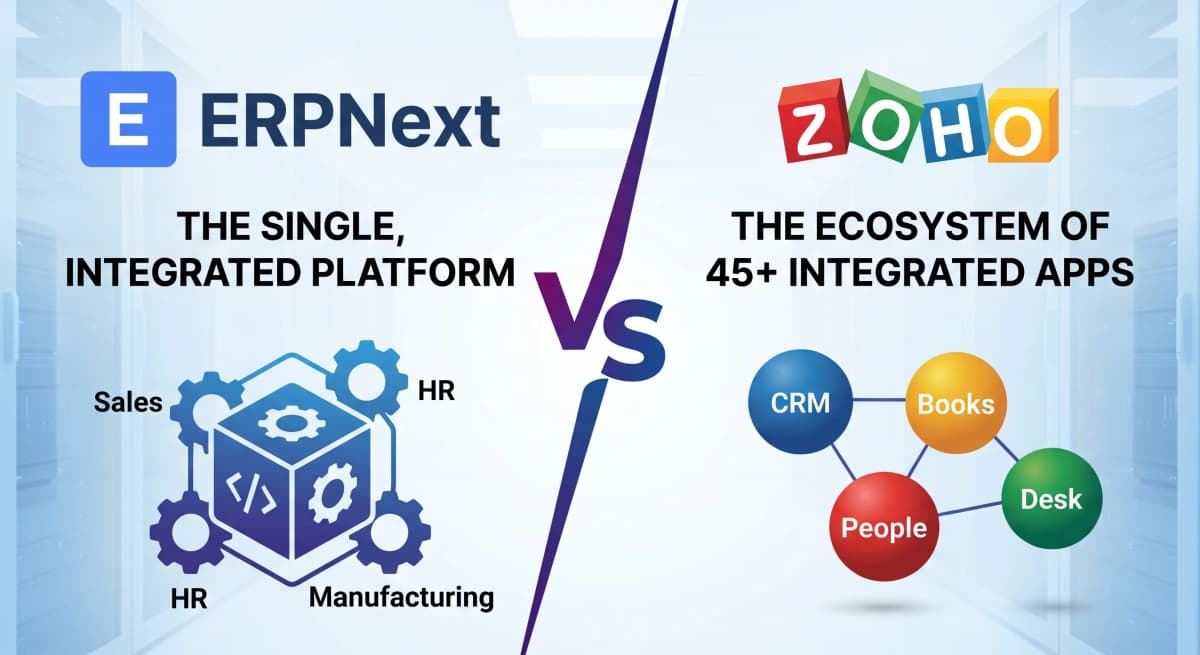
ERPNext is a single, integrated, open-source ERP platform. Every module such as sales, purchasing, manufacturing, HR, accounting, CRM, helpdesk, lives in one codebase, shares one database and works together natively. There is no stitching together of separate apps.
Zoho ERP is part of the broader Zoho One ecosystem, a suite of 45+ business apps (CRM, Books, Inventory, People, Desk, etc.) that can be purchased individually or bundled. Zoho ERP integrates these apps, but each product has its own UI, update cycle, and data layer, which can sometimes create friction.
ERPNext - Integrated Platform
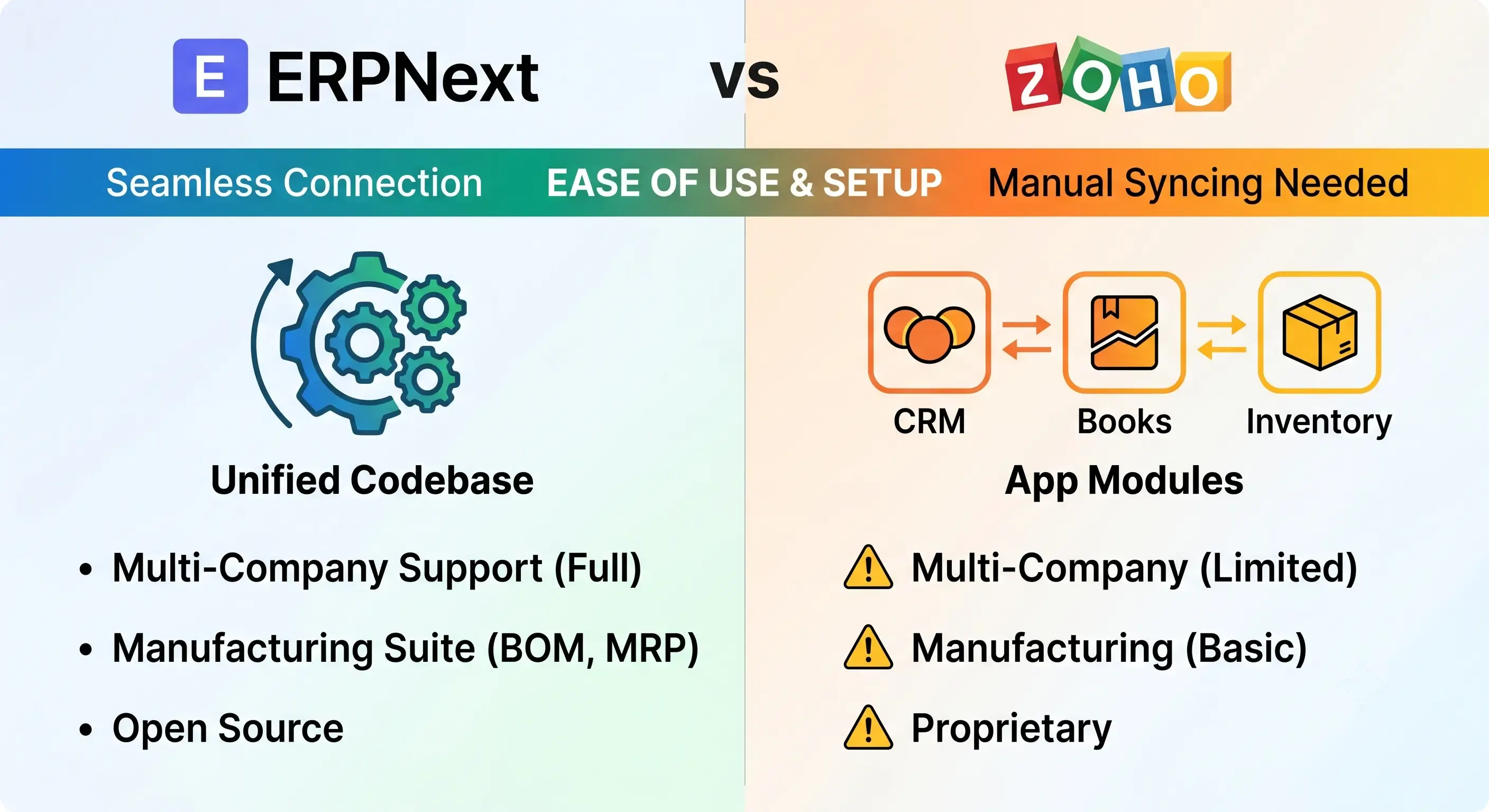
One codebase, one database, one unified experience. Every module works together natively without stitching separate apps. Open-source, self-hostable, and fully customizable.
Zoho ERP - App Suite Ecosystem
A suite of 45+ integrated apps (CRM, Books, Inventory, People, Desk). Each app has its own UI and data layer. Powerful individually but requires careful configuration to work together seamlessly.
Ease of Use & Setup
Zoho is widely regarded as easy to set up for small businesses, with a polished interface, step-by-step wizards, and minimal technical knowledge required. Individual apps can be activated independently, making it easy to start small and expand.
ERPNext also offers guided onboarding, but rewards users willing to invest some time upfront. Its unified data model means once set up, everything connects seamlessly & no manual syncing between apps needed.
Core Features Comparison
| Feature | ERPNext | Zoho ERP |
|---|---|---|
| Multi-Company Support | ✅ Full RBAC | ⚠️ Limited |
| Inter-Company Transactions | ✅ Full support | ⚠️ Limited |
| Multi-Currency | ✅ Auto rates | ⚠️ Limited |
| Multi-Language | ✅ 70+ languages | ⚠️ Basic |
| Manufacturing (BOM, MRP) | ✅ Full suite | ⚠️ Basic |
| Multiple Finance Books | ✅ Supported | ❌ Not supported |
| Distributed Cost Centers | ✅ Supported | ❌ Not available |
| Mobile Support | ✅ Fully responsive | ⚠️ Limited features |
| Open Source | ✅ Yes | ❌ No |
Finance & Accounting
ERPNext offers a significantly more powerful accounting engine. It supports multiple finance books, configurable accounting dimensions, distributed cost centers, inter-company journal entries and automated tax withholding, features designed for businesses with complex financial structures.
Zoho Books (Zoho's accounting app) is well-suited for small businesses with straightforward finances. It handles GST/VAT, basic multi-currency, bank reconciliation, and standard reporting competently. However, it lacks ERPNext's depth in areas like multi-entity consolidation, advanced budgeting, or configurable accounting periods.
CRM & Sales
Both platforms include CRM features, but there's a notable gap. ERPNext has a fully integrated CRM with lead management, opportunity tracking, pipeline visualization, quotation management, and commission structures, all within the same system as your inventory and accounting.
Zoho CRM is a dedicated, mature CRM product with strong AI-powered lead scoring (Zia AI), social media integration, and omnichannel engagement. If CRM is your primary need, Zoho's dedicated product is arguably more polished. However, data synchronization between Zoho CRM, Zoho Books, and Zoho Inventory requires careful configuration and can introduce latency.
Manufacturing & Inventory
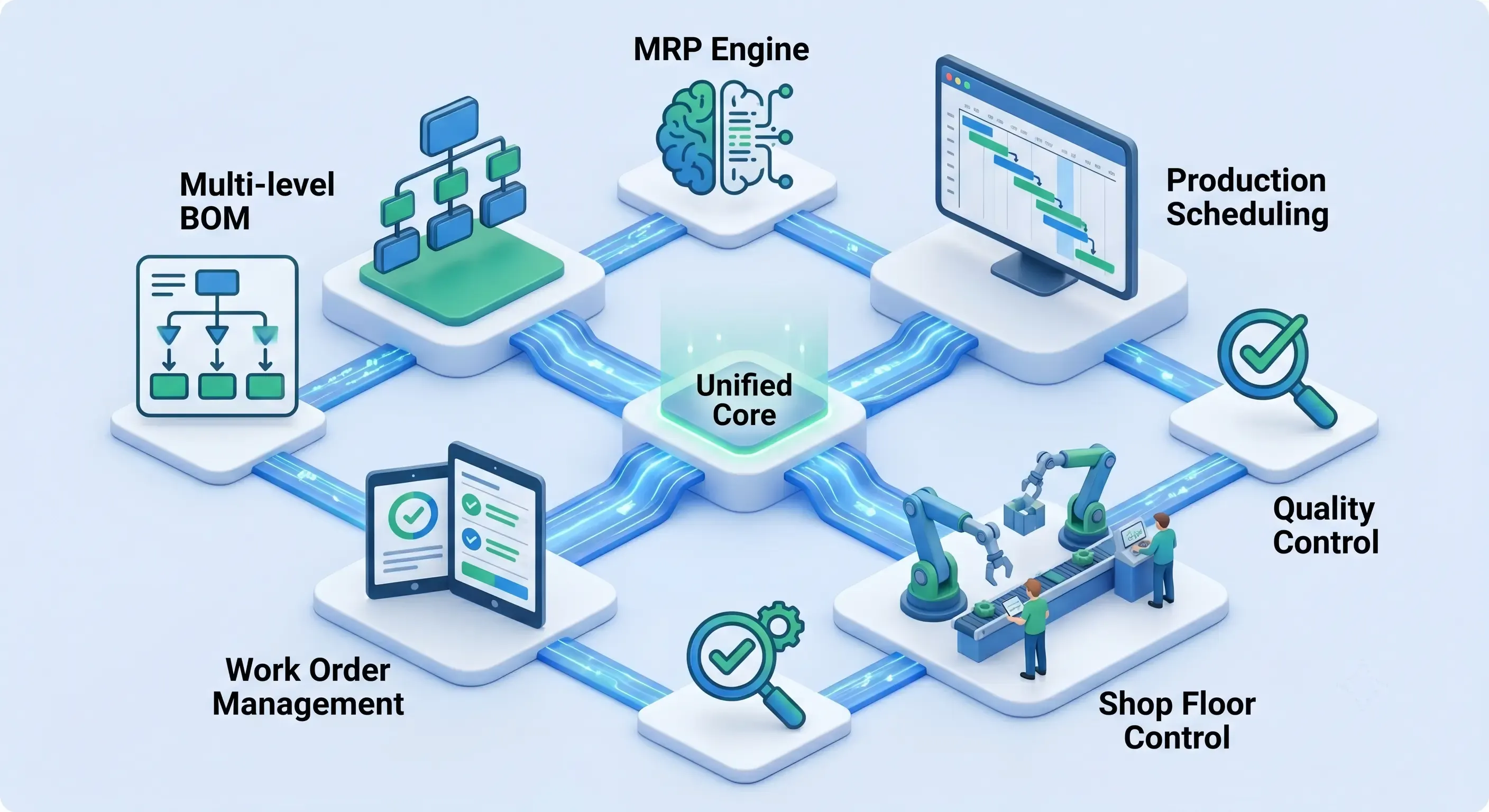
This is where ERPNext has a clear advantage. Its manufacturing module includes multi-level BOM, MRP engine, production scheduling, work order management, shop floor control, subcontracting, and quality control, all built-in at no extra charge.
Zoho's manufacturing support is basic. Zoho Inventory handles stock well for e-commerce and distribution businesses but is not designed for complex manufacturing workflows. Businesses in production environments will find ERPNext far more capable.
Customization & Extensibility
ERPNext is open-source, meaning full access to the codebase, custom Doctypes, scripted automation and community-built apps. There are no restrictions on what you can build or modify.
Zoho offers customization through Zoho Creator (a low-code app builder) and Deluge scripting. It is reasonably flexible but operates within Zoho's proprietary boundaries & you cannot self-host, access the underlying database directly, or modify core functionality.
Pricing
ERPNext
Free to Start
- •Free for self-hosted
- •Cloud plans start at ~$10/month with all modules included
Zoho One
$30/user/month
- •Starts at $30/user/month (all apps bundle)
- •Individual apps are cheaper but quickly add up as you activate more modules
ERPNext is consistently more affordable, especially as team size and module requirements grow.
Who Should Choose ERPNext?
Businesses that need manufacturing, multi-entity support, or deep financial control and want open-source flexibility without vendor lock-in.
Who Should Choose Zoho?
Small businesses and startups that primarily need CRM, accounting, and basic inventory with a polished, easy-to-use interface and don't require manufacturing capabilities.
Verdict
ERPNext is the stronger all-in-one ERP, especially for businesses with operational complexity. Zoho suits simpler setups and shines as a CRM but ERPNext's unified architecture, open-source freedom and lower cost make it the better long-term investment for most growing businesses.