ERPNext vs Odoo: A Head-to-Head Open Source ERP Comparison
A comprehensive, feature-by-feature comparison of the two leading open-source ERP platforms
Overview
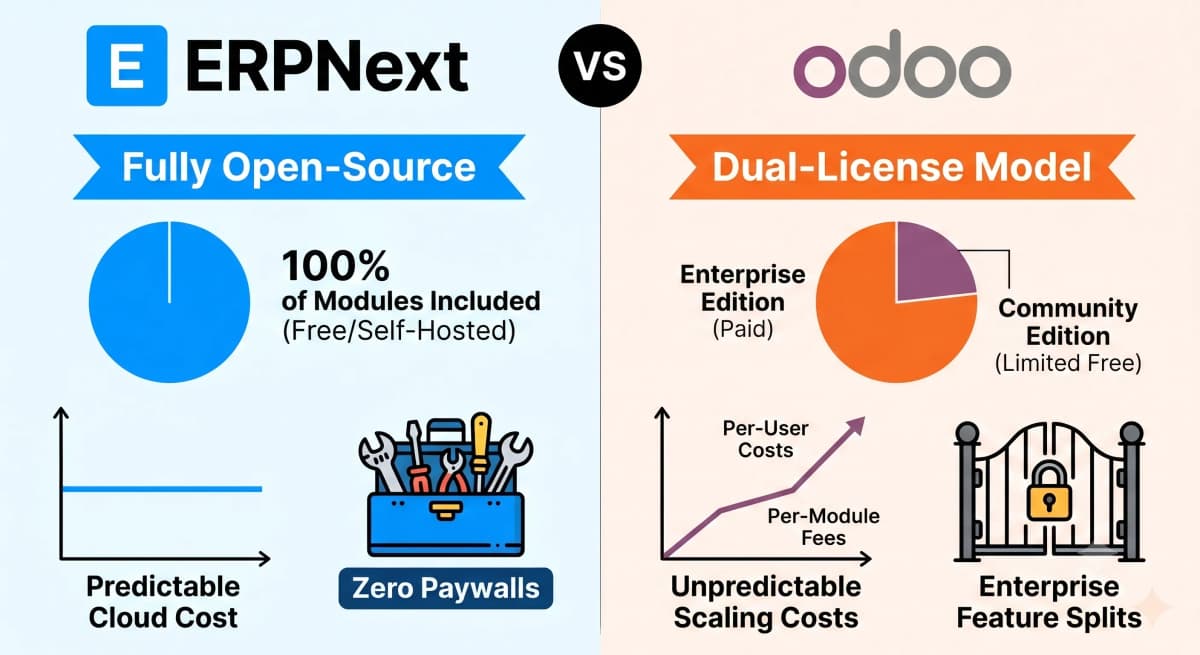
ERPNext is a fully open-source ERP built on the Frappe Framework. Every module, from accounting and inventory to HR and manufacturing, is available for free in the self-hosted version. There are no paywalled modules, no community vs. enterprise feature splits, and no per-module licensing.
Odoo started as an open-source project but has evolved into a dual-license model. The Community Edition is free but limited in features and modules. The Enterprise Edition unlocks the full feature set but requires a paid subscription per user, per module, a cost structure that can surprise businesses as they grow.
ERPNext - Fully Open Source
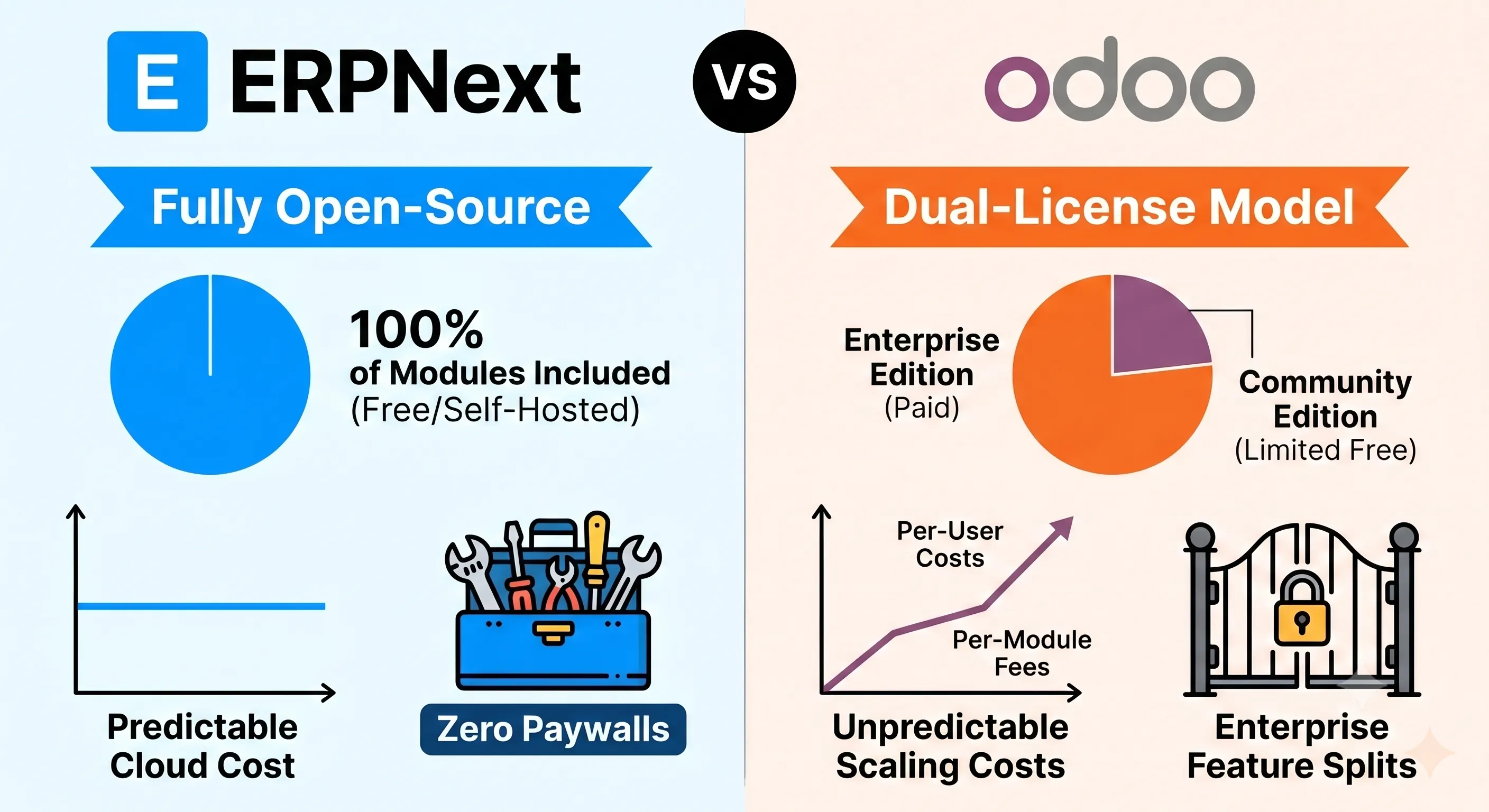
Every module is available for free in the self-hosted version. No paywalled modules, no community vs. enterprise feature splits, and no per-module licensing. Built on the Frappe Framework for deep customization.
Odoo - Dual-License Model
Started as open-source but evolved into a dual-license model. The Community Edition is free but limited. The Enterprise Edition unlocks the full feature set but requires paid subscription per user, per module.
Customization & Development
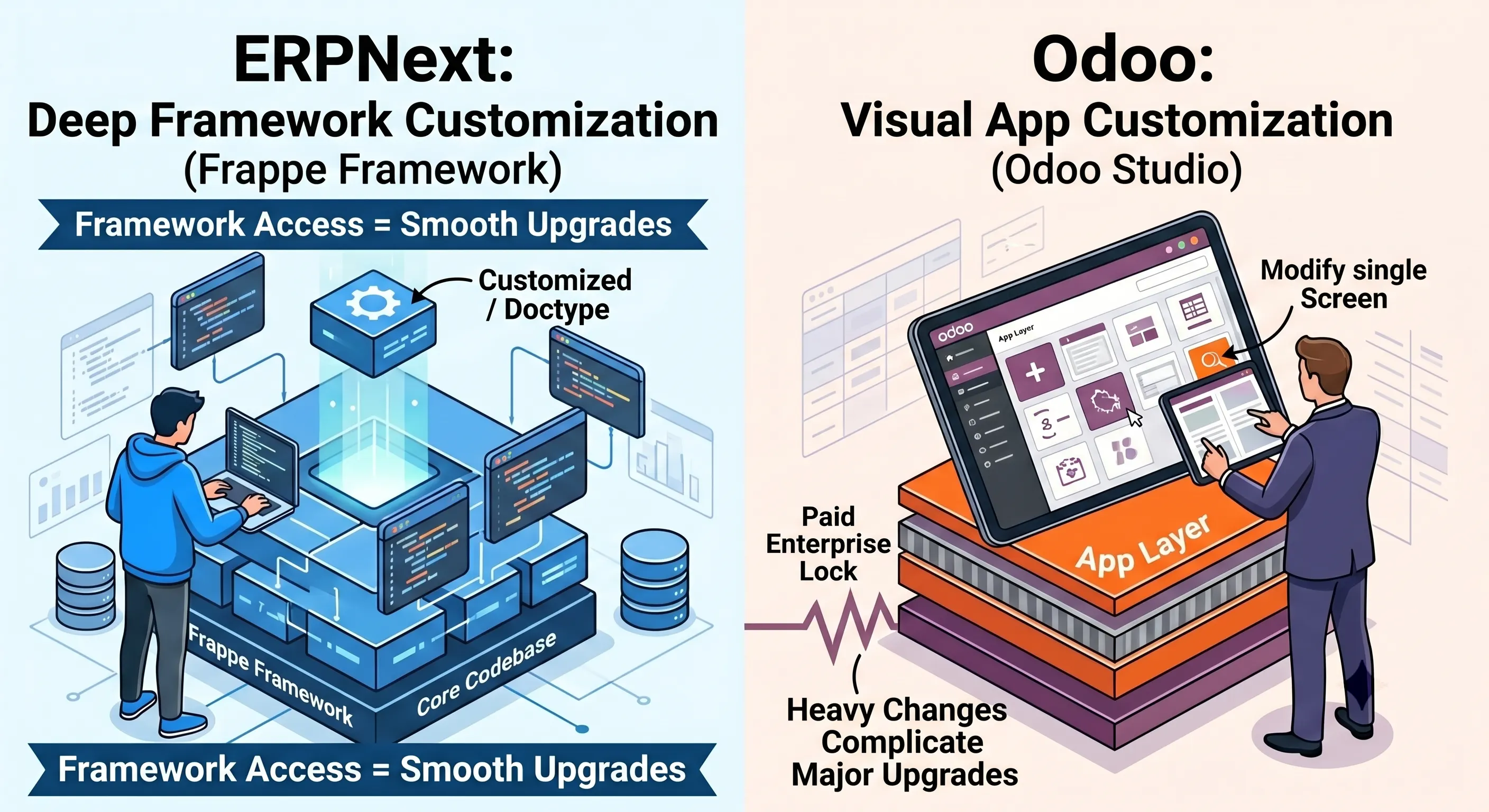
ERPNext's Frappe Framework provides deep, framework-level customization. Developers can create entirely new Doctypes, customize forms with drag-and-drop, write server-side scripts, and build custom apps, all without touching the core codebase. This makes upgrades smoother and customizations more maintainable.
Odoo offers Odoo Studio for low-code customization in the Enterprise tier, and its App Builder allows significant application-level changes. However, heavy customizations can complicate upgrades, especially when migrating between major Odoo versions, which is a known pain point in the community.
Both platforms support framework-level customization but ERPNext's open-source nature means no feature is locked behind a paywall regardless of the changes you make.
Core Features Comparison
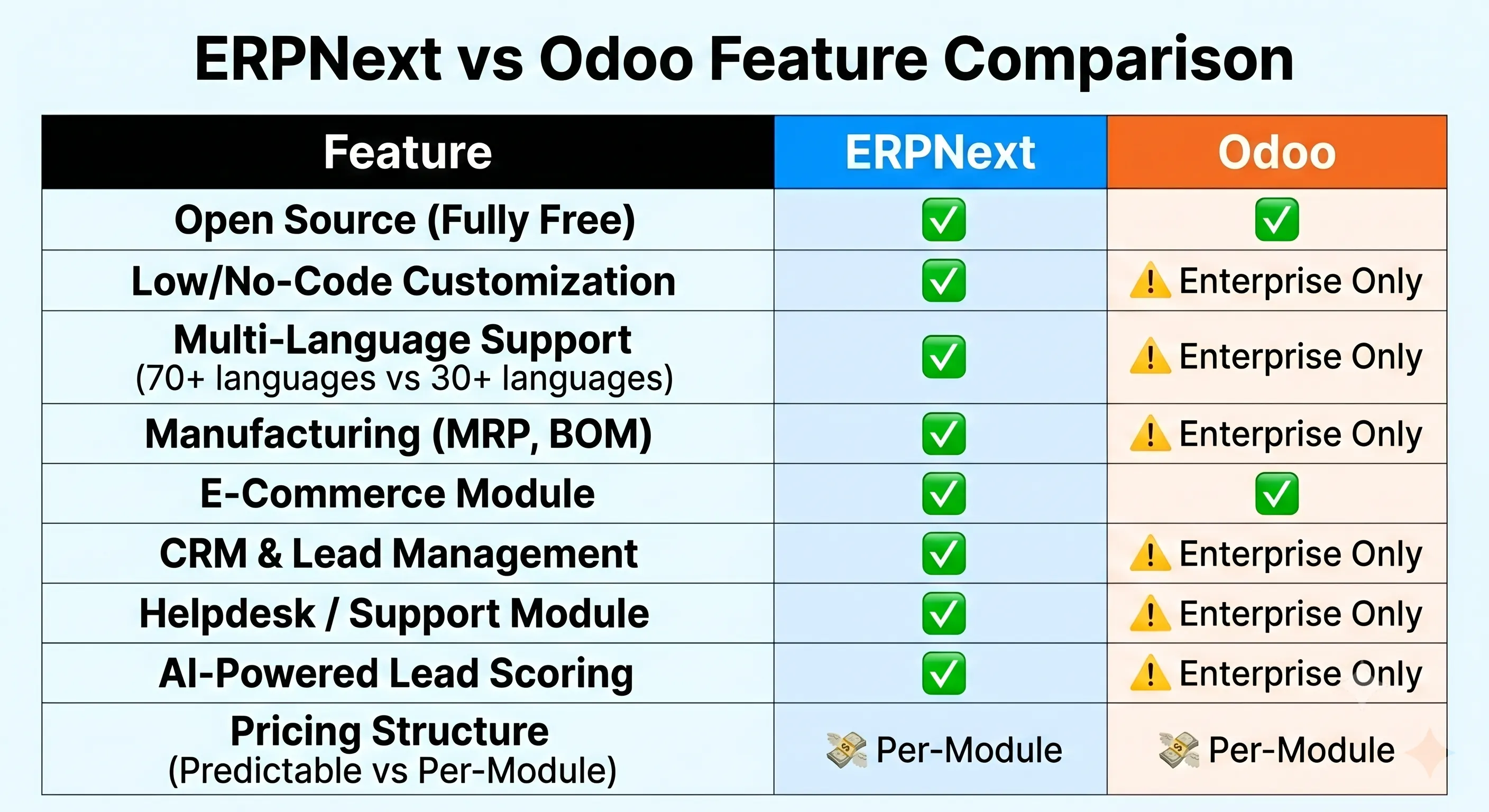
| Feature | ERPNext | Odoo |
|---|---|---|
| Open Source (Fully Free) | ✅ Yes | ⚠️ Community only |
| Low/No-Code Customization | ✅ Drag & drop | ✅ Odoo Studio (paid) |
| Multi-Language Support | ✅ 70+ languages | ✅ 30+ languages |
| Manufacturing (MRP, BOM) | ✅ Built-in | ✅ Enterprise version |
| E-Commerce Module | ✅ Built-in web store | ✅ Native module |
| CRM & Lead Management | ✅ Full CRM suite | ✅ Advanced CRM |
| Helpdesk / Support Module | ✅ Included | ✅ Available |
| AI-Powered Lead Scoring | ⚠️ Rule-based | ✅ Enterprise tier |
Finance & Accounting
Both systems offer solid accounting capabilities including multi-currency support, GST/VAT compliance, inter-company transactions, and deferred revenue management. ERPNext supports multiple finance books and configurable accounting dimensions out of the box, features that require add-ons or enterprise configuration in Odoo.
Odoo's accounting module is polished and user-friendly, with a bank synchronization interface many users find intuitive. ERPNext's accounting is more granular and suited to businesses that need deeper control over financial structures.
Inventory & Supply Chain
ERPNext and Odoo both offer comprehensive inventory management with multi-warehouse support, batch and serial tracking, barcode scanning and stock valuation methods (FIFO, Moving Average). ERPNext's perpetual inventory system and inter-warehouse transfers are fully supported out of the box.
Odoo's inventory module is visually polished with drag-and-drop putaway rules and a slick user interface but several advanced features (like multi-step routes) are locked to the Enterprise Edition.
Pricing
ERPNext
Free to Start
- •Completely free for self-hosting. All features included.
- •Cloud starts at ~$25/month with all modules included.
Odoo Community
Free
- •Free to use but missing key modules (payroll, sign, quality, etc.)
- •Limited feature set compared to Enterprise
Odoo Enterprise
$20/user/module
- •Starts at $20/user/month + per-module fees
- •A 10-user business using 5 modules can quickly exceed $500/month
For growing businesses, ERPNext's pricing model is dramatically more predictable. Odoo's per-module cost structure means expenses can scale unexpectedly.
Community & Support
ERPNext has a highly active open-source community, with regular contributions, public forums and a growing ecosystem of developers and implementation partners. Odoo's community is larger overall, but the Enterprise Edition's features are managed by Odoo S.A. with less community-driven input.
Who Should Choose ERPNext?
Businesses that want all features included at a fixed, low cost, especially those prioritizing financial transparency and long-term cost control. Great for technical teams comfortable with open-source tools.
Who Should Choose Odoo?
Companies that value polished UI/UX, need specific Odoo Enterprise features (e-signing, advanced marketing automation), and have the budget to pay per module. Odoo's interface is often considered more visually refined.
Verdict
Both are excellent open-source ERPs, but ERPNext wins on total cost of ownership and feature inclusiveness. Odoo wins on UI polish and enterprise feature depth, if you're willing to pay for it.