Claude Superpowers Explained: Skills, Plugins and Workflows
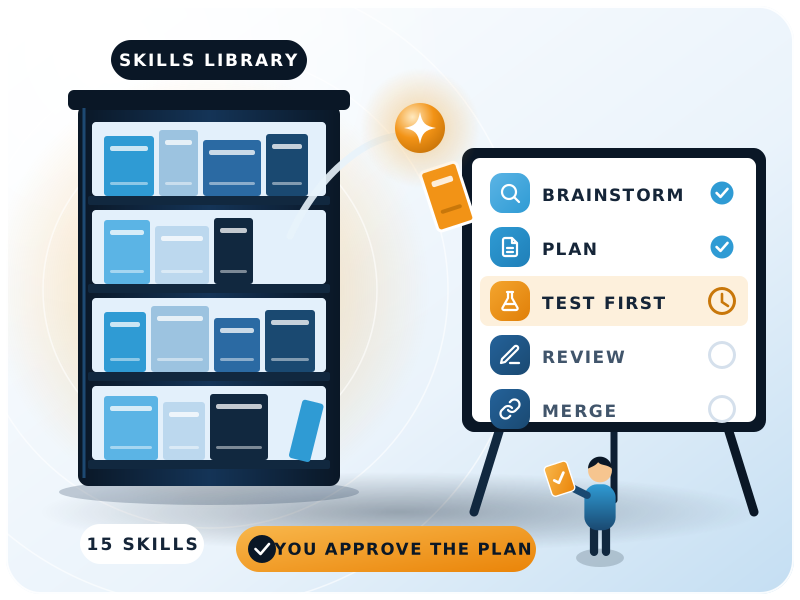
Claude Superpowers is an open-source plugin for Claude Code, written by Jesse Vincent, that adds 15 skills and makes the agent follow one fixed way of working: brainstorm, plan, test first, review, then merge. Here's how to install it, what each skill does, and how ERP teams can write skills of their own.

- Skills in the plugin
- 15
- Installs on Anthropic's plugin page
- 1.0M
- GitHub stars, 18 Nov 2026
- 319.7k
- Coding tools it supports
- 16
The short answer
What is Claude Superpowers?
In short
It isn't a hidden Claude feature. Superpowers is a package of plain-text instructions you install into Claude Code, and it shows what Claude's skills and plugin system can do for a development team. Its GitHub repository calls it a framework built on composable skills, and the code is MIT-licensed.
Jesse Vincent published Superpowers on 9 October 2025, the day Anthropic opened plugin support in Claude Code (launch post). As of 18 November 2026 the repository showed about 319,700 stars, and Anthropic's plugin page listed 1,009,371 installs.
So when people search "superpowers Claude", they usually mean this plugin. A smaller group means Claude's general abilities: writing, analysis, code and files. We cover that further down.
- Published 9 October 2025 by Jesse Vincent
- Plugin version 7.0.2, MIT licence
- About 319,700 GitHub stars (18 Nov 2026)
- 1,009,371 installs, marked "Anthropic verified"
Skills, plugins and Superpowers: how they relate
Three terms get mixed up. Here's how Anthropic's docs define them.
| Term | What it is | Where it lives |
|---|---|---|
| Skill | A folder with a SKILL.md file: a name, a description and instructions. Claude loads the body only when the task matches. | ~/.claude/skills/, a project's .claude/skills/, or inside a plugin |
| Plugin | A package of skills, subagents, hooks and MCP servers that installs as one unit, with a plugin.json manifest | Fetched from a marketplace into ~/.claude/plugins/ |
| Marketplace | A catalog file listing plugins and where to fetch them | A GitHub repo or folder, e.g. claude-plugins-official |
| Superpowers | One plugin: 15 skills, a session-start hook and a review agent | obra/superpowers on GitHub |
Anthropic announced Agent Skills on 16 October 2025, for the Claude apps, Claude Code and the API. The skills docs explain the main trick: a skill's description sits in context, but its body loads only when it's used, so long reference material costs almost nothing until it's needed.
Install and use
How do I use Superpowers in Claude Code?
Short answer
Install it once, start a new session, then just describe what you want to build. The skills fire by themselves.
/plugin install superpowers@claude-plugins-official/plugin marketplace add obra/superpowers-marketplace
/plugin install superpowers@superpowers-marketplace- 1Open Claude Code in your projectRun one of the two install commands above in the session.
- 2Start a new sessionA session-start hook tells Claude that skills exist and that it must use one when it applies.
- 3Ask for a feature in plain wordsClaude should start by asking questions (the brainstorming skill) rather than writing code.
- 4Approve the design, then the planClaude works through the tasks, reviews each one, and offers to merge, open a pull request, keep the branch or discard it.
You can also call a skill directly, for example /brainstorming. To pause it without uninstalling, disable the plugin from /plugin or run claude plugin disable in your shell (plugins docs).
Not only for Claude
The README lists 16 supported tools. Each one needs its own install.
- Claude Code
- Codex CLI
- Codex App
- Cursor
- Gemini CLI
- GitHub Copilot CLI
- OpenCode
- Antigravity
- Devin CLI
- Factory Droid
- Qwen Code
- and 5 more
The 15 skills
What skills does Superpowers add?
The repository has 15 skills. They fall into four groups.
| Group | Skill | What it makes the agent do |
|---|---|---|
| Collaboration | brainstorming | Ask questions until the intent is clear, then present a design for approval |
| writing-plans | Break work into small tasks, each with file paths, code and a check | |
| executing-plans | Run a plan in one session with a final review | |
| subagent-driven-development | Give each task to a fresh subagent, then review for spec match and code quality | |
| dispatching-parallel-agents | Run independent tasks at the same time | |
| using-git-worktrees | Work on an isolated branch so parallel tasks don't collide | |
| requesting-code-review, receiving-code-review | Review between tasks; critical issues block progress | |
| finishing-a-development-branch | Run tests, then merge, open a PR, keep or discard | |
| Testing | test-driven-development | Red, green, refactor: a failing test first, then just enough code |
| Debugging | systematic-debugging | A four-phase root-cause process |
| verification-before-completion | Prove the fix works before calling it done | |
| diagnosing-superpowers | Work out what went wrong in a session | |
| Meta | writing-skills | Write and test new skills |
| using-superpowers | Introduce the skills system to the agent |
The order matters more than any single skill. Brainstorm, worktree, plan, build with tests, review, finish. Vincent's launch post describes the same loop, and adds that he tests skills on subagents with pressure scenarios (time pressure, sunk cost) after early quiz-style tests gave misleadingly perfect scores.
Why it works
Why does a plugin like this work?
A model doesn't get smarter from a plugin. What changes is the process it's held to. In failed AI coding sessions we usually see the same pattern: the agent starts writing before it understands the request, touches too many files, and says "done" without running anything. Superpowers targets each of those habits.
Brainstorming slows the start
Small tasks limit the blast radius
"Done" means a passing test
What it costs in context
The core is light
Simon Willison, writing on 10 October 2025, quoted Vincent saying the core is "VERY token light", and that heavy implementation work goes to subagents (Willison).
Every plugin has a standing cost
Anthropic's plugin docs add a fair caveat: every enabled plugin's skill names and descriptions sit in context on every turn, even when you don't use them.
Claude's abilities
What are Claude's other "superpowers"?
Some people asking "what are superpowers in Claude?" just want to know what Claude can do. Without any plugin, Claude can write and edit text, analyse documents and data, write and review code, and create files such as spreadsheets and slides (Anthropic built that file creation on skills). Claude Code adds the ability to read a codebase, run commands and edit files in your terminal.
Superpowers sits on top of that. It doesn't add new abilities. It adds discipline to the coding ones. For how Claude compares as a day-to-day tool, see Claude vs ChatGPT for business teams.
- Write and edit text
- Analyse documents and data
- Write and review code
- Create spreadsheets and slides
- Claude Code: read a codebase
- Claude Code: run commands
Skills for ERP teams
How can business and ERP teams use skills like these?
Superpowers is built for software work. The idea behind it, writing your way of working into skills, fits business teams too. At FinByz we've built ERPNext and Frappe systems since 2016, across 200+ projects in 15+ countries. In that work we usually see the same gap: the AI tool knows Python, but not your bench layout, your deploy rules, or which doctypes must never be touched on production. Skills close that gap.
Custom app work
House style
Repeatable checklists
Team sharing
A first ERPNext skill
It can be this short. The description is what Claude reads to decide when to load it, so make it specific.
---
name: erpnext-custom-app
description: Rules for changing our ERPNext custom app. Use before editing any doctype, hook or patch.
---
1. Work on a git branch, never on the live bench.
2. Test new code against a copy of the site, then roll back.
3. Ask before running bench migrate or touching Sales Invoice data.
Where to start: write down one task your team repeats and explains badly to new hires. That's your first skill.
Superpowers vs a custom skill
| Question | Superpowers | Your own skill |
|---|---|---|
| Who writes it | Jesse Vincent and Prime Radiant | Your team |
| Best for | General software process | Your systems, rules and style |
| Updates | From the marketplace | When you edit the file |
| Knows your ERP setup | No | Yes, if you write it in |
| Effort to start | One command | An hour for a first version |
Most teams end up with both: Superpowers for process, a few project skills for local knowledge. If you're weighing agent frameworks rather than coding plugins, our open-source AI agent frameworks comparison covers that side.
Limits
When should you not use Superpowers?
It isn't right for every job.
Quick one-off edits
Brainstorming and a plan for a one-line fix are overhead. You can skip a skill or disable the plugin for that session.
Non-code work
Its skills assume a git repo and tests. For drafting letters or analysing a spreadsheet it adds little.
Strict security reviews
Anthropic's docs say a plugin can run code on your machine with your user privileges, and that Anthropic can't verify that plugins will work as intended. Read the hooks and skills before you install, and pin versions if your policy requires it.
Teams without tests
TDD needs a test runner. On an ERPNext custom app with no tests, start by adding a few; otherwise the loop has nothing to check.
Security
Is Superpowers safe to install in a company?
Short answer
Treat it like any open-source dependency. The source is public and MIT-licensed, and you can read every skill as plain Markdown.
Anthropic's plugin security page lists the review steps:
- 1Check the marketplace sourceRun claude plugin marketplace list to see where each marketplace was added from.
- 2Read the details paneIn /plugin, select the plugin. The Will install section lists its commands, agents, skills, hooks and servers.
- 3Read the hooksOpen hooks/hooks.json in the plugin's folder to see the command each hook runs.
- 4Set company rulesAdmins can allowlist marketplaces through managed settings.
The README also notes one network call: the brainstorming visual companion loads a logo that sends the Superpowers version. Setting SUPERPOWERS_DISABLE_TELEMETRY turns it off, and Claude Code's own telemetry opt-outs are honoured.
Next step
Next step
Install Superpowers on a test repository and build one small feature with it. Watch where it slows you down and where it saves you a rework. Our OpenClaw vs Claude Code guide explains where Claude Code fits among AI agents, and the Claude for small business guide covers plans and team setup.
If you want the same discipline for your ERPNext custom apps, or skills that hold your team's process, talk to our AI automation team or see our ERPNext AI services.
- Install Superpowers on a test repository
- Build one small feature with it
- Note where it slows you down
- Write your first project skill
Sources
- obra/superpowers on GitHub: README and plugin.json v7.0.2, checked 18 November 2026
- Claude Marketplace: Superpowers plugin page, checked 18 November 2026
- Jesse Vincent: Superpowers, how I'm using coding agents in October 2025, 9 October 2025
- Anthropic: Introducing Agent Skills, 16 October 2025
- Claude Code docs: Skills
- Claude Code docs: Plugins overview
- Claude Code docs: Plugin security and trust
- Simon Willison: Superpowers, 10 October 2025