Introduction

The best ERP software for small manufacturing businesses is ERPNext, Odoo, SAP Business One or NetSuite. ERPNext is open source with built-in production planning at low cost; Odoo lets you start with a few apps and add more as you grow; SAP Business One adds MRP and shop-floor control; NetSuite is a cloud ERP covering finance, inventory and orders.
Small manufacturers face unique challenges in today's competitive business environment. From optimizing production processes to inventory control and supply chain management, staying efficient and agile is crucial. This is where Enterprise Resource Planning (ERP) software comes into play, revolutionizing how small manufacturers operate and grow. In this blog, we’ll explore the best ERP for small business tailored to meet the needs of manufacturing companies.
Understanding the Need for ERP in Small Manufacturing Businesses
Many small manufacturers operate with limited staff and resources. Traditional methods like spreadsheets and disconnected systems can lead to inefficiencies, errors, and missed growth opportunities. ERP for small business helps streamline processes, increase transparency, and fuel business growth effectively.
What to Look for in ERP Software for Small Businesses
Choosing the right ERP system is critical for your small manufacturing company. Look for ERP for small business solutions that offer value for money, are scalable, easy to use, and provide features tailored to your industry. Essential features include:
Small businesses need budget-friendly options that deliver high ROI. Look for the best ERP for small business that comes with low initial investment and flexible pricing models.
The best ERP for small business should feature an intuitive interface so your team can get started quickly with minimal training.
Manufacturing software for small business should include features like inventory management, quality control, production scheduling, and supply chain optimization to support manufacturing-specific workflows.
Cloud-based ERP for small business ensures that small manufacturers remain connected and flexible, enabling access to key data from any location at any time.
The Top ERP Solutions for Small Manufacturing Businesses
1. ERPNext

ERPNext is a powerful ERP for small business offering comprehensive features at a low cost. As an open-source platform, it supports production planning, CRM, inventory, and more making it a reliable manufacturing software for small business.
2. Odoo
Odoo is another top contender when it comes to the best ERP for small business. Its modular approach allows small manufacturers to start with essential apps and scale up as they grow making it flexible and future-ready manufacturing software for small business.
3. SAP Business One

While SAP is typically associated with large enterprises, SAP Business One offers a simplified version tailored for small businesses. It’s a capable ERP for small business, supporting material requirements planning (MRP), shop floor management, and other critical features in manufacturing.
4. NetSuite
NetSuite is a leading cloud-based ERP for small business, providing full visibility and control over key operations. As a comprehensive manufacturing software for small business, it includes tools for finance, inventory, and order management all in one platform.
Manufacturing ERP for Small Business Compared
The four systems above, plus two more that small manufacturers often shortlist, compared side by side. All cover inventory, purchasing and sales. They differ in how you pay, where they run and how deep the production features go, which is what decides the fit for a small manufacturer.
| ERP | Licence model | Deployment | Manufacturing features | Best fit |
|---|---|---|---|---|
| ERPNext | Open source (no licence fee); you pay for hosting, implementation and support | Cloud or self-hosted | BOMs, work orders, job cards, production planning, quality inspection, batch and serial tracking | Small and mid-size manufacturers that want a full ERP at low running cost and room to customise |
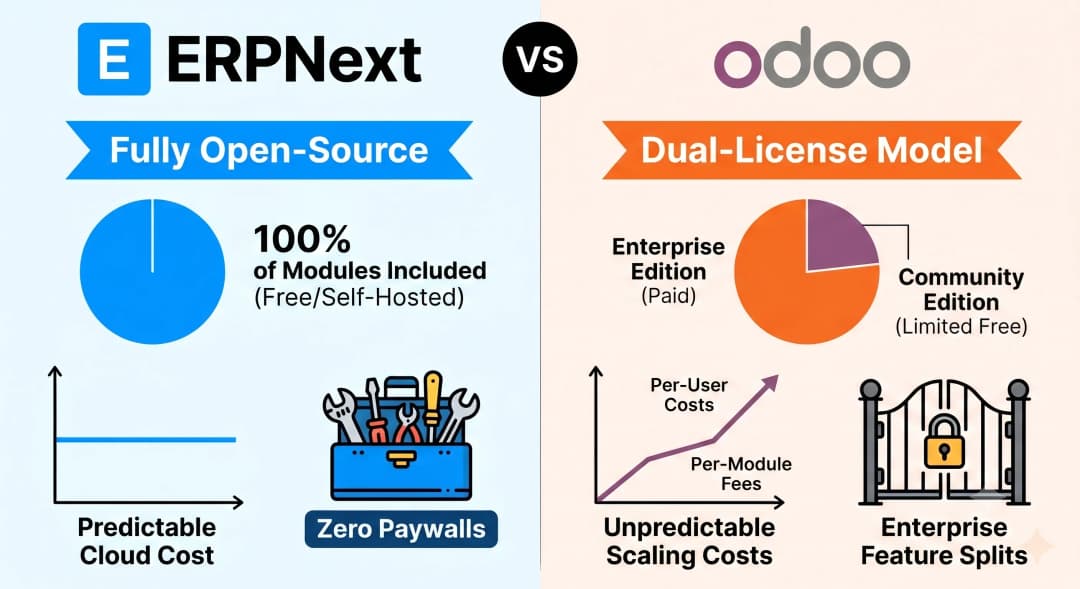
| Odoo | Free Community edition; Enterprise edition is a per-user subscription | Cloud or self-hosted | Manufacturing (MRP) app with BOMs and work orders; PLM, quality and maintenance apps in Enterprise | Companies that want to start with a few apps and add more later |
| SAP Business One | Per-user licence or subscription bought through an SAP partner | On-premise or partner-hosted cloud | MRP, production orders and BOMs; deeper shop-floor control through partner add-ons | Growing manufacturers that want the SAP brand and a partner-led setup |
| NetSuite | Annual subscription (SaaS only) | Cloud only | Assemblies and work orders; advanced manufacturing as an extra module | Firms that want a fully hosted system and have a larger software budget |
| Microsoft Dynamics 365 Business Central | Per-user monthly subscription; manufacturing needs the Premium licence | Microsoft cloud or on-premise | Production BOMs, routings, production orders and MRP planning | Small manufacturers already on Microsoft 365 with a Microsoft partner |
| Katana | Monthly subscription | Cloud only | Manufacturing orders, BOMs, real-time stock and simple MRP; accounting stays in QuickBooks or Xero | Very small make-to-order makers and e-commerce brands that do not need a full ERP yet |
For a feature-by-feature view of the two open-source options, see ERPNext vs Odoo.
How to Choose Manufacturing ERP Software for a Small Business
Shortlist two systems, then run a demo with your own items, BOMs and one real customer order from start to finish. Use this checklist while you compare:
- Your production type: make-to-stock, make-to-order or job work. Check that the ERP handles it without workarounds.
- BOM and routing depth: multi-level BOMs, operations, workstations and scrap or by-products if you have them.
- Stock control: batch and serial numbers, reorder levels and stock in more than one warehouse.
- Quality: inspection at receipt, in process and before dispatch, with records you can show an auditor.
- Costing: material, labour and overhead on each work order, so you know the real margin per product.
- Local tax and e-invoicing: GST, VAT or the e-invoice format your country requires.
- Total cost over 3-5 years: licences, hosting, implementation, training and support, not just the first year.
- Partner support: a team that knows manufacturing and can stay with you after go-live.
What Does Manufacturing ERP Cost a Small Business?
The cost of manufacturing ERP for a small business depends on four things: the licence model, the number of users, where it is hosted and how much setup work your processes need. Subscription systems such as NetSuite charge every year for each user; open-source ERPNext has no licence fee, so most of the budget goes to implementation and support.
| Cost item | What drives it |
|---|---|
| Licence or subscription | Number of users and modules; nil for open-source ERPNext and Odoo Community |
| Hosting | Vendor cloud, your own cloud server or on-premise hardware |
| Implementation | Data migration, BOM and item set-up, workflows, reports and print formats |
| Customisation and integrations | Machines, e-commerce, shipping, tax portals or other software you need to connect |
| Training and support | Number of users, go-live support and the yearly support plan |
For a fixed scope and a clear estimate, see our ERPNext for manufacturing service or talk to a consultant.
The Benefits of ERP for Small Business in the Manufacturing Sector
Implementing ERP for small business in the manufacturing industry offers transformative advantages, helping streamline operations and enhance overall performance.
Streamlined Operations

The best ERP for small business consolidates all core functions-manufacturing, sales, inventory, and procurement-into a unified system. This integration reduces manual processes, minimizes errors, and significantly improves efficiency and productivity.
Better Decision-Making

With real-time data analytics capabilities, ERP for small business empowers manufacturers to make timely and accurate decisions. Whether optimizing inventory or adjusting production schedules, access to current data supports strategic planning.
Enhanced Customer Satisfaction

Manufacturing software for small business improves customer service by ensuring timely deliveries, accurate orders, and seamless communication throughout the supply chain. Satisfied customers are more likely to return and refer your business to others.
Cost Savings

The best ERP for small business reduces costs by automating routine tasks, cutting operational waste, and maximizing resource utilization. Cloud-based solutions further reduce expenses by eliminating the need for extensive IT infrastructure.
Scalability

As your business evolves, scalable ERP for small business allows you to add users, modules, and functionalities without system overhauls. This flexibility ensures the ERP adapts to your growing operational needs.
Compliance and Risk Management

In the regulated manufacturing environment, ERP for small business ensures traceability, accurate records, and adherence to compliance standards. This reduces risks related to audits and legal penalties.
Competitive Advantage

Leveraging manufacturing software for small business enables you to quickly adapt to market changes, fulfill customer demands, and outperform competitors. Agility is key to sustained business success.
Conclusion
In conclusion, ERP software is not just for large corporations-ERP for small business is a strategic investment that can unlock growth, optimize operations, and build customer loyalty in the competitive manufacturing landscape.
Whether you're seeking cost-efficiency, scalability, or industry-specific features, the best ERP for small business can be tailored to fit your goals. With the right solution, your small manufacturing business can thrive and stay ahead in a dynamic market.