AI Automation Agency: What It Does, Costs and How to Choose
An AI automation agency designs, builds and runs software that takes repetitive work off your team, using AI where the work needs judgment and plain rules where it doesn't. Here's what you get, how agencies charge and how to pick one.

- Organisations using AI regularly in at least one function (McKinsey, 2025)
- 88%
- Scaling AI agents somewhere in the business (McKinsey, 2025)
- 23%
- Agentic AI projects Gartner expects to be cancelled by end of 2027
- 40%+
- Questions to put to every agency before you sign
- 8
The basics
What does an AI automation agency do?
In short
An AI automation agency turns a manual business process into a workflow that runs mostly on its own. The good ones start with one process you can measure, connect it to the systems you already use, and keep it working after go-live.
That last part is where agencies really differ. A demo that reads one invoice is easy. A process that reads 400 invoices a week, posts them to the right ledger in your ERP and asks a person when it isn't sure is a different job. The work usually has five parts.
- 1Process reviewMap how the work is done today, who touches it, how long it takes and where errors creep in.
- 2DesignDecide which steps need AI (reading an email, classifying a document, drafting a reply) and which just need rules (if the amount is above a limit, send for approval).
- 3Build and integrateConnect the AI model to your ERP, CRM, email, WhatsApp or document store through their APIs, with the right permissions.
- 4Test on real dataRun the workflow on last month's documents or tickets and compare its output with what your team did.
- 5Run and improveMonitor errors, model costs and edge cases after go-live, and adjust prompts, rules and approvals.
How is AI related to automation?
Classic automation follows fixed rules. It breaks when the input is messy, and AI covers the messy part. In practice, almost every useful workflow is a mix: the AI step reads and decides, then rule-based steps check, post and log.
Rules
AI
Is an AI automation agency the same as AI automation consulting?
Not quite. An AI consultant or AI automation consulting firm mostly advises: which processes to automate, which tools fit, what the risks are and what a rollout plan should look like. An AI automation company or agency also builds and runs the result. Many firms do both, so ask whether the people giving advice are the same people who'll write and support the code.
Typical projects
| Process | What gets automated | Where a person stays in the loop |
|---|---|---|
| Accounts payable | Read supplier invoices, match them to purchase orders, draft the purchase invoice | Mismatches and new suppliers |
| Collections | Draft payment reminders from the receivables ageing, log replies | Disputes and promises to pay |
| Sales | Qualify inbound leads, enrich them, draft first replies | Pricing and proposals |
| Customer support | Answer common questions from your own documents, route the rest | Complaints and refunds |
| HR | Screen resumes against a role, schedule interviews | Shortlist and offer decisions |
| Reporting | Pull figures from the ERP and write a weekly summary | Sign-off before it's shared |
The market
Why are so many companies hiring an AI automation agency now?
Most companies are already experimenting with AI, but few have moved it into daily operations. McKinsey's State of AI in 2025 survey, published in November 2025, found that 88 percent of respondents say their organisation uses AI regularly in at least one business function, yet nearly two-thirds say they haven't started scaling AI across the enterprise. In the same survey, 62 percent say they're at least experimenting with AI agents and 23 percent are scaling them somewhere in the business.
The gap between "we tried ChatGPT" and "the process runs itself" is integration, data and change management. That's the work an agency sells.
There's also a warning in the numbers. In June 2025 Gartner predicted that over 40 percent of agentic AI projects will be cancelled by the end of 2027, citing escalating costs, unclear business value and inadequate risk controls. Gartner also called out "agent washing", where vendors relabel chatbots and existing tools as AI agents. An agency that can show real, measured work beats one with the most impressive deck.
Are AI agents worth it?
They're worth it when the task is frequent, the inputs vary and a wrong answer can be caught before it does damage. Reading supplier invoices fits. Approving a large payment on its own doesn't, at least not yet. Most AI automation agencies will push agents; ask them to show which steps of your process really need one and which are better as plain rules. Our guide to deploying enterprise AI agents on ERP goes deeper on that split.
Pricing
How much does AI automation cost?
The honest answer
There's no single figure, because cost depends on the process, the systems involved and how much risk you can accept. What you can compare is how agencies charge and what drives the total.
Common pricing models
| Model | How it works | Works well when | Watch out for |
|---|---|---|---|
| Fixed-price discovery | A short paid assessment that ends with a process map, a design and an estimate | You're not sure which process to start with | A report with no estimate or no clear first workflow |
| Fixed price per workflow | One agreed scope, one price | The process is well defined and the systems are known | Change requests priced at a premium |
| Time and materials | You pay for hours or a dedicated developer | Scope will change, or you want several workflows over time | No weekly visibility of hours and progress |
| Monthly retainer | Ongoing monitoring, fixes and small changes | The workflow is live and business-critical | Paying for hours nobody uses |
| Outcome-based | Fee linked to volume processed or time saved | Results are easy to count | Disputes over how “saved” is measured |
What drives the total cost
Number of systems
Quality of your data
Risk level
Volume
Ongoing care
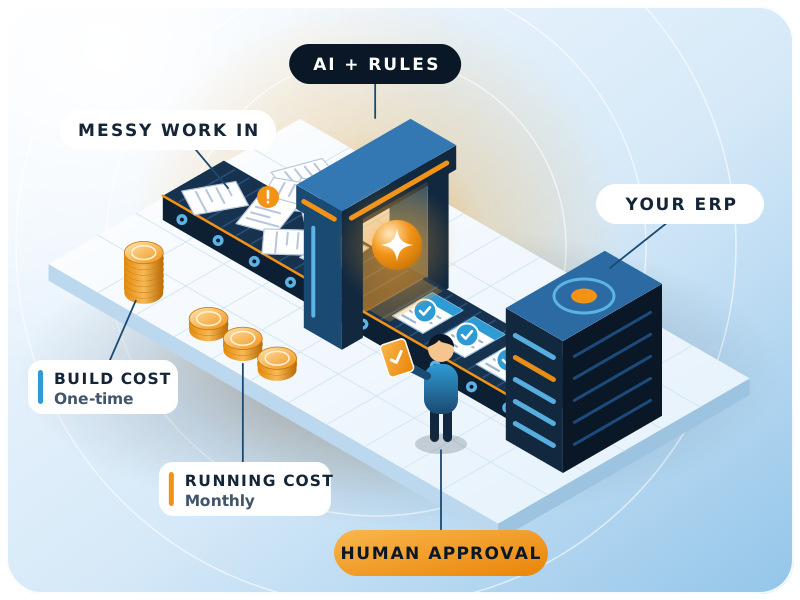
Build vs running cost
Selection
How do you choose an AI automation agency?
Start with the process, not the agency. Write down one process, how many times it runs a month, how long it takes and what a mistake costs you. Then put these eight questions to every agency you talk to.
Selection checklist
- 1Similar work they can showAsk for a live demo on a similar process, not slides. If they claim ERP experience, ask to see the integration, not just the chatbot.
- 2Knowledge of your systemsAn agency that knows your ERP's data model and permissions builds something that fits. One that only knows the AI side copies data out into a separate tool.
- 3A clear first workflowA good proposal picks one process, defines success in numbers you already track and keeps the first phase small.
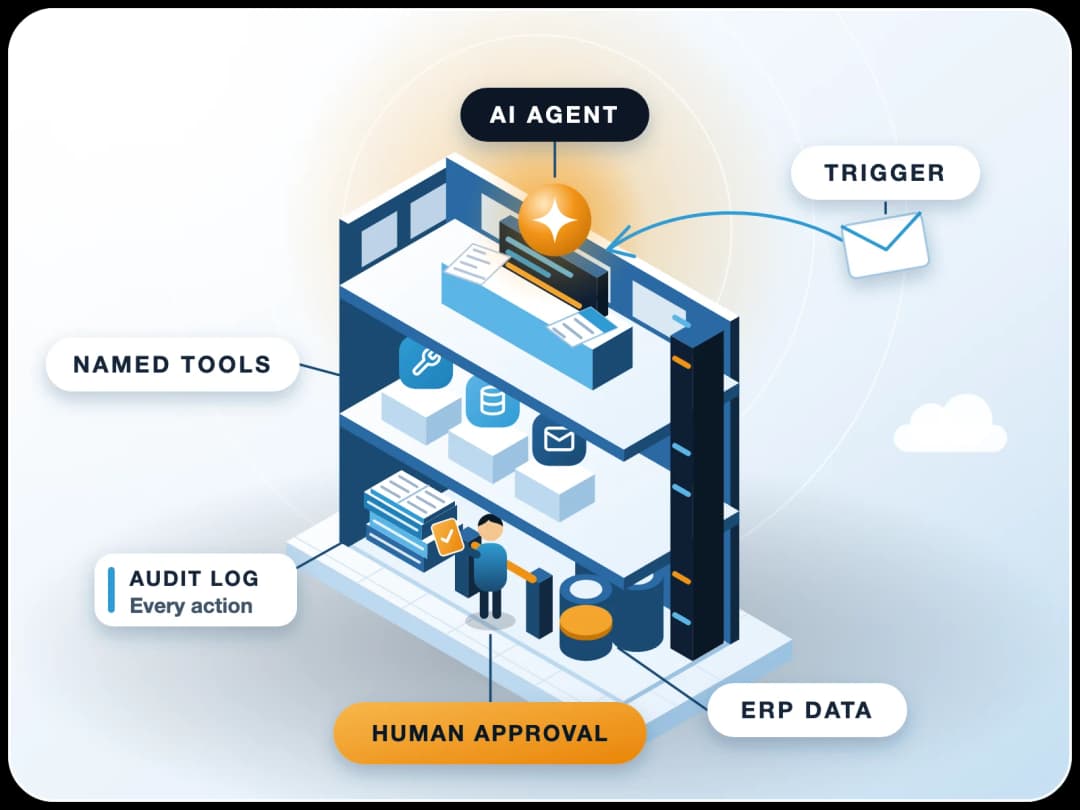
- 4Human approval designed inAsk exactly which actions the automation can take without a person, and how a person approves the rest.
- 5Security and data handlingWhere do prompts and documents go? Which model provider is used, and under what data terms? Does the automation use its own user with limited permissions?
- 6OwnershipWho owns the code, prompts and workflows? Can you move them to another partner or an in-house team later?
- 7Support after go-liveWho watches errors and model costs, and how fast do they respond?
- 8Exit planIf you stop working together, what do you get: source code, documentation, credentials handed back?
Red flags in a proposal
- A promise of “full autonomy” from day one, with no approval step.
- Fixed ROI percentages before anyone has looked at your data.
- The automation logs in with an administrator account.
- No mention of how errors, retries or duplicate actions are handled.
- Workflows that live only in the agency's own account, with no export.
- Everything is called an “AI agent”, even simple rule-based steps.
Bring a security reference to the meeting. The OWASP Top 10 for LLM Applications (2025) lists prompt injection as the top risk (LLM01) and "excessive agency" (LLM06): an AI system with more functions, permissions or autonomy than its task needs. Ask the agency how its design handles both. For a wider governance view, NIST's AI Risk Management Framework (AI RMF 1.0, January 2023) groups the work into four functions: govern, map, measure and manage.
Comparison
Agency vs in-house team vs freelancer: which is right?
| Factor | AI automation agency | In-house team | Freelancer |
|---|---|---|---|
| Speed to first workflow | Fast, if they've built similar ones | Slow, hiring and learning first | Fast for small, well-defined tasks |
| Range of skills | Process, AI, integration and support in one team | Depends on who you hire | Usually one specialist |
| Knowledge of your business | Builds up over the project | Deepest over time | Limited |
| Continuity | Contract-based, ask about the team | Strong while people stay | Risky if the person moves on |
| Best fit | First few workflows, or when ERP integration is involved | Many workflows, AI is core to the product | One-off scripts or prototypes |
A mixed approach is common. An agency builds the first workflows and sets up the patterns, while one or two people on your side learn to maintain them. Over time the agency moves to a smaller support role. If you go that way, put knowledge transfer in the contract.
Limits
When should you not hire an AI automation agency?
Not every problem needs AI, or an agency. Hold off when:
The process isn't settled
If every manager does it differently, automate after you agree how it should work.
Volume is low
A task that takes two hours a month rarely pays back a custom build.
The data is unreliable
Clean the master data first. AI on top of bad data makes confident mistakes faster.
A built-in feature already does it
ERPNext, for example, has auto-repeat, assignment rules, email alerts and bank reconciliation tools. Use those before paying for something custom.
Nobody owns it
An automation without an owner on your side slowly breaks and nobody notices.
From our projects
What we've learned from ERP and AI automation projects
FinByz has delivered 200+ projects in 15+ countries since 2016, most of them on ERPNext, and in recent years many have added AI to existing ERP processes. A few patterns repeat.
Keep the automation close to the ERP
Drafts beat direct posting at the start
Running costs need watching
Open code keeps options open
Next step
What should you do next?
Pick one process, measure it for two weeks (volume, time per item, error rate) and take those numbers to two or three agencies. Ask each one for a discovery scope, a first-workflow proposal with build and running costs split out, and a demo on similar work. The answers will tell you more than any ranking list.
If ERPNext or Frappe is part of your stack, our AI automation services team can review the process with you, and our ERPNext AI page shows what we've built inside the ERP. For a second opinion on a proposal you've already received, talk to our AI consulting team, or see how our AI implementation service runs a first workflow.
- One process, measured for two weeks
- Two or three agencies, same brief
- Build and running costs split out
- A demo on similar work, not slides
Sources
- McKinsey & Company: The state of AI in 2025: Agents, innovation, and transformation, November 2025
- Gartner: Gartner Predicts Over 40% of Agentic AI Projects Will Be Canceled by End of 2027, Press release, 25 June 2025
- OWASP GenAI Security Project: Top 10 for LLM Applications 2025
- NIST: AI Risk Management Framework (AI RMF 1.0), January 2023
- Frappe Framework: REST API
- ERPNext: User Permissions
- FinByz AI repository (GPL-3.0)