Accounts Receivable Accounting: Meaning, Examples and AI
Accounts receivable is the money customers owe you for goods or services already delivered on credit. It sits on the balance sheet as a current asset until they pay. Here's how to account for it, track it and automate collections in ERPNext with AI, with a person still approving.

- Where AR sits on the balance sheet
- Current asset
- IFRS 9 expected credit loss model in force since
- 1 Jan 2018
- Longest agreed payment term to Indian MSEs (MSMED Act)
- 45 days
- Interest on late MSE payments, compounded monthly
- 3x RBI bank rate
The basics
What is the meaning of accounts receivable?
Accounts receivable definition
Accounts receivable (AR) is the money owed to a business by its customers for sales made on credit. You've shipped the goods or finished the service, raised an invoice with terms such as "Net 30", and the customer hasn't paid yet. Until they do, you hold a legal right to that cash.
In accounts receivable accounting, the job is threefold: record it correctly, collect it on time, and write off what will never come in. IFRS financial statements usually show it as "trade receivables" or "trade and other receivables" under current assets.
AR isn't revenue. Revenue is recognised when you deliver; receivables only track whether the cash has arrived. A company can post strong sales and still run short of cash because too much of that revenue is stuck in AR.
What are the types of receivables?
People usually split receivables three ways:
Trade receivables
Notes receivable
Other (non-trade) receivables
Asked "what are the two types of accounts receivable?", most accountants say trade and non-trade. Notes receivable becomes the third category once a written note is involved.
Balance sheet
Is accounts receivable an asset?
Short answer
Yes. Accounts receivable is a current asset. Under IAS 1, an asset is current when the business expects to realise it within its normal operating cycle or within twelve months after the reporting period. Most invoices fall due in 30 to 90 days, so trade receivables fit easily.
Why it counts as an asset
It's a resource you control (a right to cash) that came from a past event (the sale). That right can be pledged, factored or sold, which is why banks lend against it.
Why its quality gets checked
It isn't cash yet. Lenders and auditors look at how old the invoices are and how much of the balance is likely to be collected, which is where the allowance for credit losses comes in.
Worked example
How does accounts receivable accounting work? (Journal entries)
You sell goods worth 100,000 to a customer on Net 30, with 18% GST (18,000) on the invoice. The figures are illustrative.
1. When you raise the invoice
| Account | Debit | Credit |
|---|---|---|
| Accounts Receivable (Debtors) | 118,000 | |
| Sales | 100,000 | |
| Output GST | 18,000 |
2. When the customer pays 118,000 into the bank
| Account | Debit | Credit |
|---|---|---|
| Bank | 118,000 | |
| Accounts Receivable (Debtors) | 118,000 |
3. When a balance turns out to be uncollectable
Say another customer's 20,000 invoice will never be paid. First you build an allowance (a provision for doubtful debts): debit Bad Debt Expense, credit Allowance for Doubtful Accounts. When the loss is confirmed, debit the Allowance and credit Accounts Receivable for 20,000.
The allowance isn't guesswork. IFRS 9 (effective for annual periods beginning on or after 1 January 2018) uses an expected credit loss model, so you estimate losses before they happen. US GAAP did the same through ASC 326, the CECL standard FASB issued in June 2016, which also covers trade receivables that aren't yet due.
In ERPNext, entries 1 and 2 post on their own when you submit a Sales Invoice and a Payment Entry. The allowance is usually a Journal Entry your accountant posts at month-end.
Can you give an example of a trade receivable?
A furniture maker delivers 40 office chairs to a coworking company on 1 March, invoices the same day on 30-day terms, and gets paid on 28 March. For those 27 days, the invoice amount is a trade receivable on the furniture maker's books.
Ageing
What is accounts receivable ageing and why does it matter?
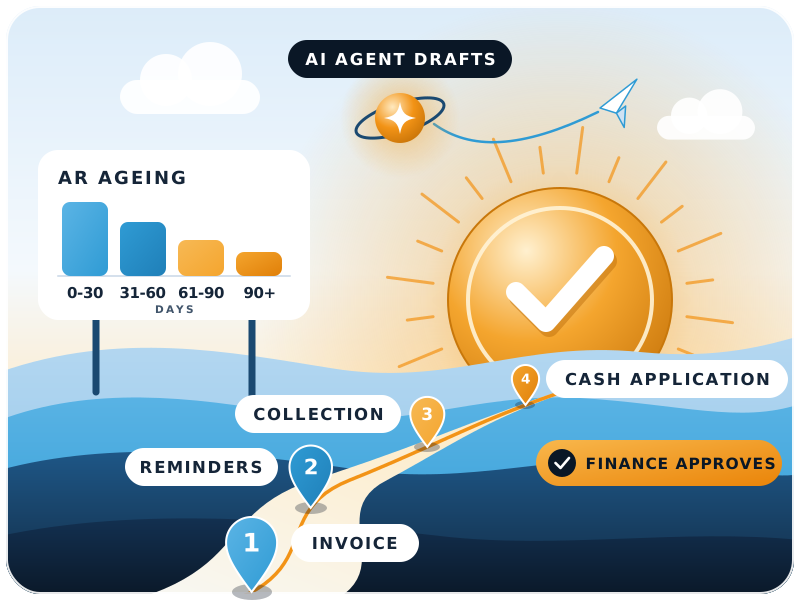
An AR ageing report groups unpaid invoices by how long they've been outstanding. It's the most useful collections report there is, because old invoices are harder to collect than new ones.
- 0-30 days
- 31-60 days
- 61-90 days
- 90+ days
In ERPNext, the Accounts Receivable report builds this from the Payment Ledger. You choose whether ageing runs from the posting date or the due date, set your own ranges, and filter by customer, customer group, territory, sales person, cost center or project. A payment-terms view splits one invoice across its instalments, which matters when a customer pays 50% on order and 50% on delivery.
What we usually tell finance teams: run ageing on due date, not posting date, for collections work. Posting-date ageing makes Net 60 customers look late when they aren't.
Metrics
Which accounts receivable metrics should you track?
| Metric | Formula | What it tells you |
|---|---|---|
| Days Sales Outstanding (DSO) | (Accounts receivable / Credit sales for the period) x Days in the period | Average days it takes to collect |
| AR turnover | Credit sales / Average accounts receivable | How many times a year you collect your average balance |
| % overdue | Overdue AR / Total AR | Share of the book past its due date |
| Collection effectiveness index (CEI) | (Opening AR + Credit sales - Closing AR) / (Opening AR + Credit sales - Current AR) x 100 | How much of what could be collected actually was |
| Bad debt ratio | Write-offs / Credit sales | What credit losses cost you |
Track DSO by customer group, not only for the whole company. One large late payer can hide behind a healthy average.
Process
What does the invoice-to-cash cycle look like?
Accounts receivable is the middle of a longer process, often called order-to-cash or invoice-to-cash:
- 1Credit checkApprove the customer and set a credit limit before the first order.
- 2Order and deliverySales Order, then Delivery Note.
- 3InvoiceRaise an accurate invoice with the right terms, tax and PO reference. Most disputes start here.
- 4Reminders and statementsTell customers what's due before and after the due date.
- 5CollectionCalls, dunning letters, escalation for large or old balances.
- 6Cash applicationMatch each bank receipt to the right invoice.
- 7Reporting and provisioningAgeing, DSO, expected credit loss, write-offs.
Steps 4, 5 and 6 eat most of a typical AR team's week. That's why they're the first targets for automation.
Automation
How does AI automate accounts receivable in ERPNext?
ERPNext already handles the rule-based part of AR without any AI. AI earns its place in the parts that need reading and judgement: messy remittance emails, customer replies, and deciding who to chase first.
What ERPNext does out of the box
Credit limits
Dunning
Process Statement of Accounts
Payment Request
Payment Reconciliation
Bank Reconciliation Tool
Where AI adds value on top
| AR task | Rule-based ERPNext | With an AI agent |
|---|---|---|
| Reminders | Same template for everyone | Drafts a message in the right tone using payment history, open disputes and the last reply |
| Cash application | Matches when the reference is clean | Reads remittance emails and PDFs, proposes which invoices a lump-sum payment covers |
| Collection priority | Sort the ageing report by amount | Ranks accounts by amount, age, past behaviour and promise-to-pay notes, and gives the reason |
| Customer replies | A person reads every email | Classifies replies (paid, dispute, promise to pay, wrong contact) and logs them against the invoice |
| Disputes | Found when the customer complains | Flags invoices with missing PO numbers, price mismatches or short deliveries before they go out |
| Credit review | Fixed limit until someone changes it | Summarises a customer's payment trend for the credit manager to decide |
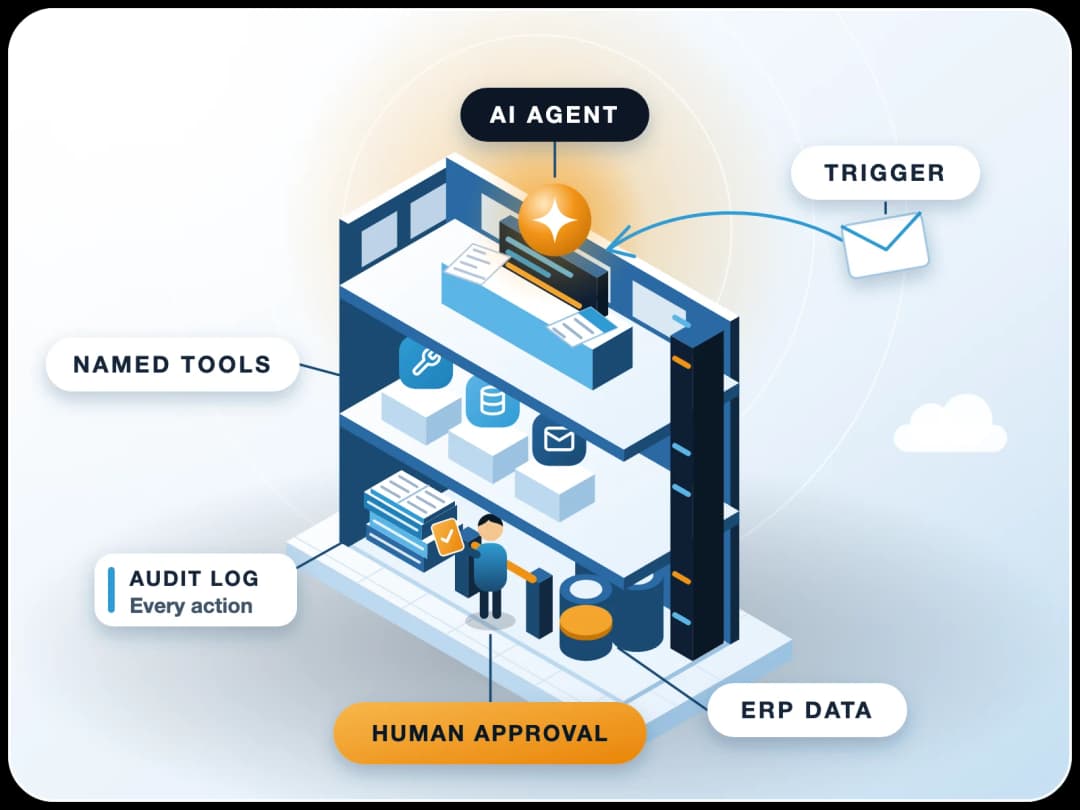
The agent drafts
A draft reminder, a proposed allocation, a suggested priority list. Nothing is sent or submitted yet.
A person approves
A finance user checks the batch in one screen and submits. We use this pattern on every AR agent.
How-to
How do you set up AI accounts receivable automation in ERPNext?
- 1Clean the master data firstCorrect billing contacts on every customer, the right payment terms template, and credit limits that reflect reality. AI on bad data just makes confident mistakes faster.
- 2Switch on the standard featuresDunning Types, Process Statement of Accounts and Payment Requests cover a lot before you write any AI code.
- 3Measure the baselineNote your DSO, % overdue and the hours spent each week on reminders and cash application.
- 4Create a separate ERP user for the agentRead access to Sales Invoice, Payment Entry, Customer and Communication; create rights only for drafts. Never run it as Administrator.
- 5Start with one taskReminder drafting or remittance matching are good first picks. Run it in shadow mode for two to four weeks: the agent proposes, staff work as usual, and you compare.
- 6Add an approval stepA workflow state or a review list, so nothing reaches a customer and no payment is allocated without a person's OK.
- 7Widen slowlyAdd collection prioritisation or reply classification once the first task holds up against the baseline.
You can build the agent inside a custom Frappe app or run it in an orchestration tool that calls the Frappe REST API, as we describe in AI agent orchestration with n8n. Either way, ERPNext stays the system of record and every change shows in the document's version history. Our guide to deploying enterprise AI agents on ERP covers the governance side in more depth.
From practice
What mistakes do we usually see in AR automation?
These are general patterns from ERPNext work, not results from one project.
Automating a broken process
Letting the agent submit
One template for every customer
Trusting remittance emails blindly
No owner
Limits
When should you not use AI for accounts receivable?
- Low volume, good payers. A few dozen invoices a month from customers who pay on time? ERPNext's standard reminders and statements will do the job at no extra cost.
- Anything with legal weight. Write-offs, settlement offers, interest claims and legal notices stay with people.
A note for Indian MSE suppliers
If you sell as a registered micro or small enterprise, the MSMED Act caps the agreed payment period at 45 days and makes a late buyer pay compound interest at three times the RBI bank rate (MSME Samadhaan). Section 43B(h) of the Income-tax Act, inserted by the Finance Act 2023, also delays the buyer's tax deduction until it pays. As of November 2026, that puts MSE suppliers in a strong position when they chase payment. An AI reminder can mention it, but a person should decide when to raise it.
Work with us
How FinByz can help
FinByz has implemented ERPNext since 2016, with 200+ projects in 15+ countries and a 50+ member in-house team. We set up the AR side of ERPNext properly first (credit limits, payment terms, dunning, statements), then add AI agents for reminders, cash application and collection priority, each with its own user, draft-only rights and an approval step.
See our ERPNext AI work. If your receivable balances don't tie out yet, start with opening balance reconciliation or an accounting transaction audit. Our AI implementation service covers the rollout.
Next step: pull your ageing report, pick the one AR task that takes your team the most hours, and talk to us about a shadow-mode pilot on your own data.
Sources
- IFRS Foundation: IAS 1 Presentation of Financial Statements
- IFRS Foundation: IFRS 9 Financial Instruments, Effective 1 January 2018
- Deloitte IAS Plus: How the CECL standard affects nonbanks (ASU 2016-13)
- ERPNext docs: Accounts Receivable report
- ERPNext docs: Credit Limit
- ERPNext docs: Dunning
- ERPNext docs: Process Statement of Accounts
- ERPNext docs: Payment Request
- ERPNext docs: Payment Reconciliation
- ERPNext docs: Bank Reconciliation Tool
- Frappe Framework: REST API
- Ministry of MSME: MSME Samadhaan (delayed payments, Section 16 interest)
- Business Standard: 45-day MSME payment rule and Section 43B(h) explained, 26 March 2024