SAP ERP ECC End of Support: Move to S/4HANA or ERPNext?
SAP ERP ECC loses mainstream maintenance at the end of 2027, and paid extended maintenance stops at the end of 2030. Here are the dates, the four paths open to you, and when a mid-size company should move to ERPNext instead.
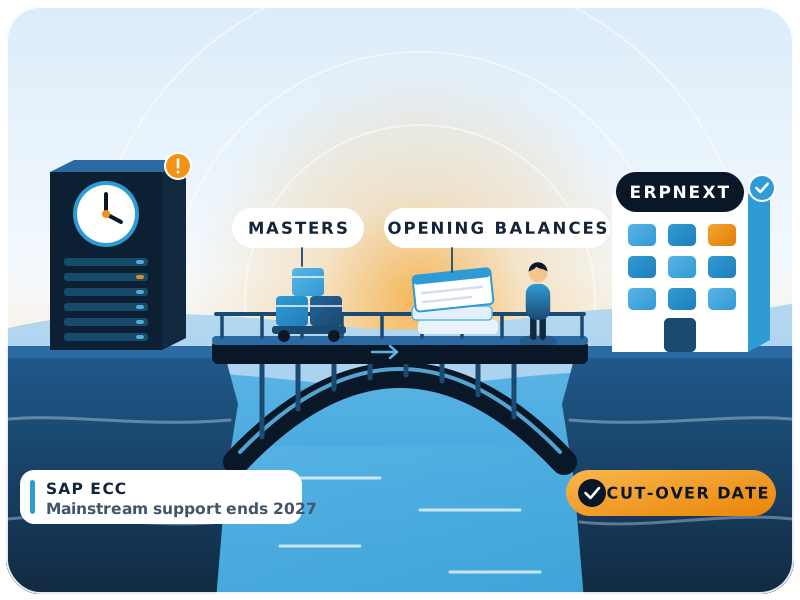

- Mainstream maintenance for SAP ECC ends
- 31 Dec 2027
- Optional extended maintenance, at a premium, runs to
- End of 2030
- ECC customers that had licensed S/4HANA by Sept 2024 (Gartner)
- 37%
- Software licence fee for ERPNext (GPL v3 open source)
- None
The basics
What is SAP ECC, and how is it different from S/4HANA?
In short
If you run SAP ECC today, you have three real paths: convert to S/4HANA, pay for more time inside SAP's cloud, or move to a different ERP such as ERPNext. For a large group with heavy SAP customisation, S/4HANA is usually the safe bet. For a mid-size company that uses a fraction of ECC and pays for all of it, the deadline is a good moment to ask a blunter question: do we need SAP at all?
SAP ECC (SAP ERP Central Component) is the core of SAP Business Suite 7. It covers finance, controlling, sales and distribution, materials management, production planning and the other classic SAP modules.
It grew out of R/3, the client-server product SAP launched in 1992, which itself followed R/2 (started in 1979) and the financial accounting software SAP had built by 1975, sometimes called R/1, according to SAP's company history.
Classic SAP ECC modules
- Finance (FI)
- Controlling (CO)
- Sales and distribution (SD)
- Materials management (MM)
- Production planning (PP)
Is SAP HANA the same as S/4HANA?
SAP HANA is the database
S/4HANA is the ERP suite
SAP ECC end of support
When does SAP ECC support end?
Short answer
Mainstream maintenance ends on 31 December 2027. SAP announced the timeline in February 2020 and confirmed in January 2025 that the 2027 date had not moved (The Register, 28 Jan 2025). Dates below are as SAP publishes them, as of 16 November 2026.
31 Dec 2027
Mainstream maintenance ends
For core SAP Business Suite 7 applications, including ECC (SAP News, 4 Feb 2020).2028 to 2030
Optional extended maintenance
At a premium of two percentage points on the existing maintenance basis. Skip it, and you drop to customer-specific maintenance from 2028: fixes for known issues at unchanged fees.31 Dec 2030
Last date to reach SAP ERP, private edition
Systems must be on SAP ERP, private edition (on HANA) to qualify for the transition option (SAP News, 4 Aug 2025, updated 13 Oct 2026).2031 to 2033
Transition option for eligible RISE customers
SAP's 13 Oct 2026 update says subscriptions may run to 31 Dec 2035, with further prerequisites.2040
SAP's maintenance commitment for S/4HANA
Announced in the same February 2020 release.
Customer-specific maintenance sounds harmless, but read it carefully. It covers problems SAP already knows about. Don't plan on new legal changes or new tax rules arriving for an ECC system on that track.
Your exact enhancement package level also matters, so check your own system against SAP's maintenance pages before you put a date in a board paper.
Your four paths
What options do ECC customers have before 2027?
There are four, and most companies quietly pick one by doing nothing. That's the expensive way to choose.
1. Convert to S/4HANA
2. Buy extended maintenance
3. RISE and the transition option
4. Leave SAP for another ERP
SAP S/4HANA migration
Is SAP S/4HANA migration difficult?
For a typical ECC customer, yes
Not because S/4HANA is badly built, but because 15 or 20 years of ECC leaves a lot behind. That's true whether you call it a migration, a conversion or a fresh S/4HANA implementation.
- Custom ABAP code has to be checked against the new data model.
- Old enhancement packages may need an upgrade first.
- Business partners replace separate customer and vendor masters.
- Finance moves to the Universal Journal.
- Every interface to banks, tax portals and warehouse systems needs a fresh test.
37%
of ECC customers had licensed S/4HANA by September 2024, up from 34% a year earlier, per Gartner as reported by The Register. Licensed isn't the same as live, either. Many of those companies still had the actual conversion ahead of them.
The mid-size view
Why do mid-size companies look at ERPNext instead?
Mid-size firms often bought SAP years ago because a parent company, a big customer or an auditor expected it. Today they use finance, purchasing, sales, inventory and some production planning. They pay SAP-level maintenance and SAP-level consulting rates for that.
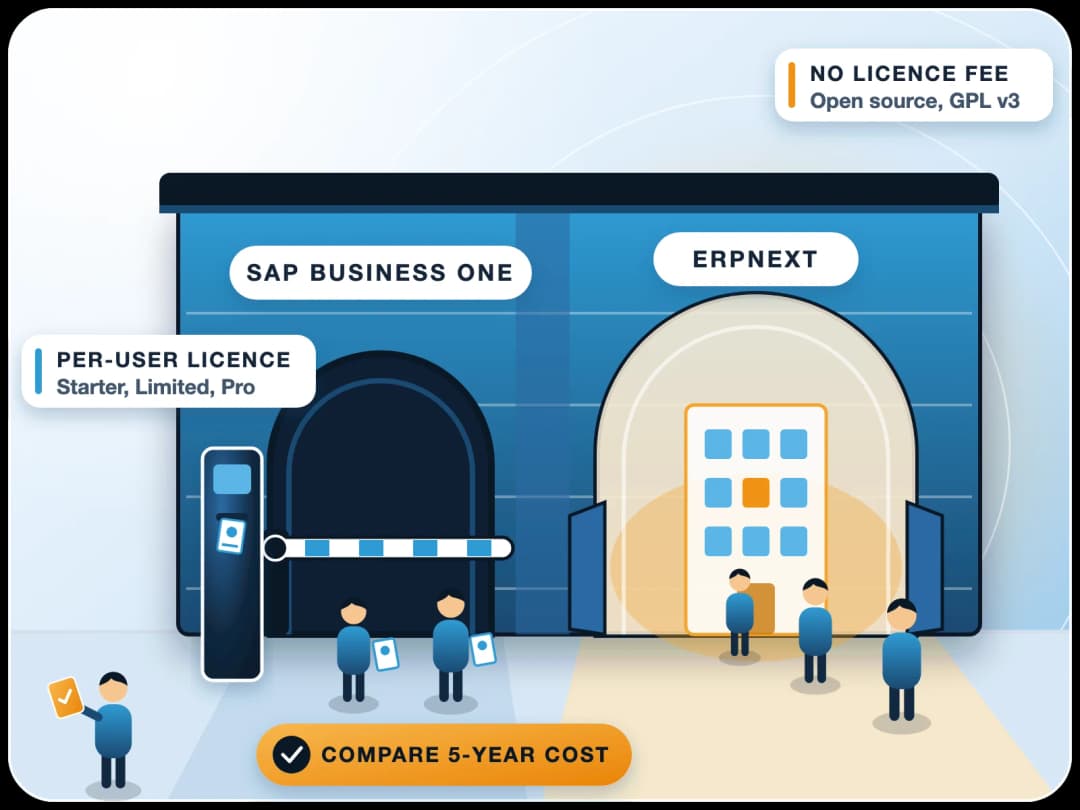
ERPNext covers the same core: accounting, buying, selling, stock, manufacturing, projects, assets and quality, with HR and payroll in the Frappe HR app. It's open source under the GNU GPL v3 (ERPNext on GitHub), so there's no per-user licence fee for the software itself. You pay for implementation, hosting and support, and you can change partner without changing software. See the full list of ERPNext modules.
Costs depend on scope, so we don't quote numbers here. The pattern in the table below is what matters. Three of the four columns keep you on SAP's price list.
How the paths compare for a mid-size ECC customer
| Path | S/4HANA conversion | Extended maintenance | RISE transition option | Move to ERPNext |
|---|---|---|---|---|
| Stays on SAP | Yes | Yes | Yes | No |
| Support horizon | 2040 (SAP commitment) | End of 2030 | 2033, possibly 2035 | Open source, community and partner support |
| Licence model | SAP licence or subscription | Existing licence plus 2 points | RISE subscription plus uplift | No software licence fee (GPL v3) |
| Database | SAP HANA only | Unchanged | SAP HANA only | MariaDB (open source) |
| Who it suits | Large, complex SAP users | Companies buying time | SAP's largest customers (2 TB+) | Mid-size firms using SAP's core only |
| Main risk | Long, costly conversion | Decision only delayed | Locked deeper into SAP | Change management, data migration |
Limits
When is ERPNext not the right fit?
We'd steer you away from ERPNext in a few cases. Be honest about these before you start.
SAP industry solutions
A parent that mandates SAP
SAP-certified partners
Custom ABAP as your edge
If none of these apply and you use mostly standard finance, purchasing, sales, inventory and production, ERPNext is worth a proper look.
SAP ECC to ERPNext
How do you migrate from SAP ECC to ERPNext?
This is the approach we use on ERP migrations to ERPNext. It works with or without an SAP consultant on your side.
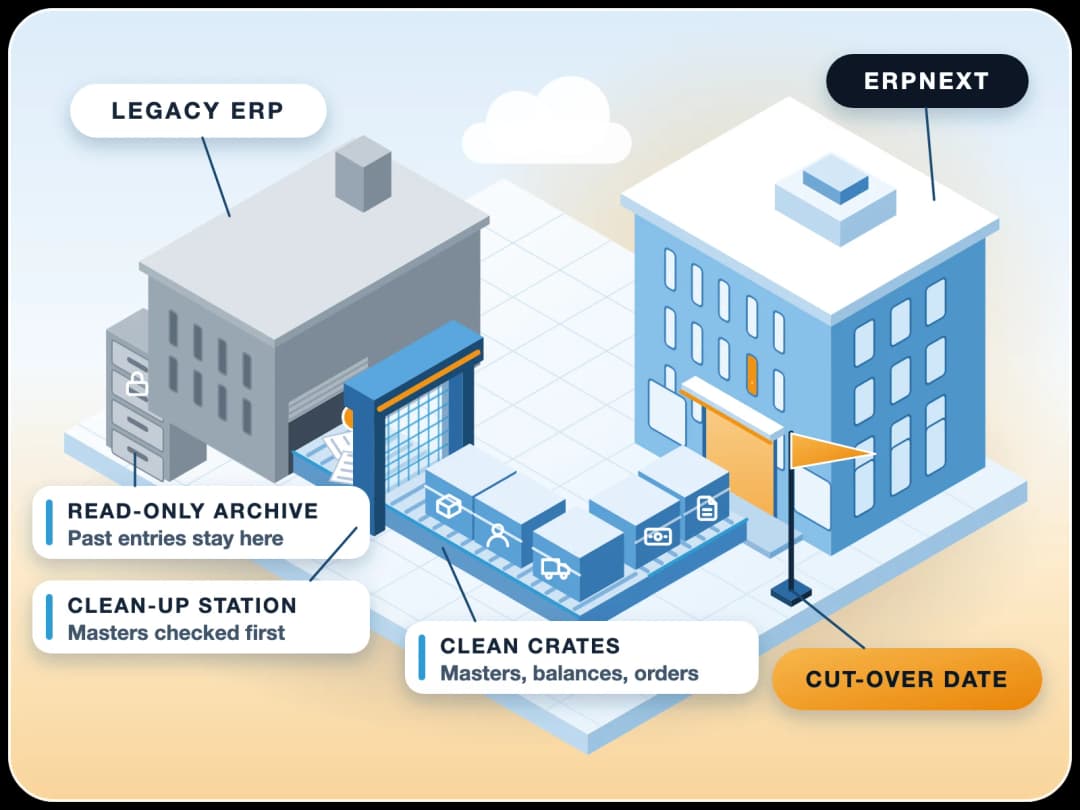
- 1Freeze the scopeList the ECC transactions people actually use. Pull usage logs if you can. In our experience a large share of configured functionality turns out to be unused, so this step shrinks the project.
- 2Map the mastersCompany codes, chart of accounts, cost centres, materials, customers, vendors, plants and storage locations each get a home in ERPNext (see the table).
- 3Pick a cut-over dateA financial year start or a month end keeps it clean. Run both systems for one closing cycle at most.
- 4Move masters, then balancesLoad masters with the Data Import tool. Bring open receivables and payables in with the Opening Invoice Creation Tool, stock with Stock Reconciliation, and trial balance figures as an opening Journal Entry.
- 5Rebuild only what you needReplace custom ABAP reports with ERPNext reports or a custom app on the Frappe Framework. Rebuild interfaces with the REST API.
- 6Test with real month-end dataClose a month in both systems and compare the trial balance, the stock valuation and the receivables ageing line by line.
- 7Keep ECC read-only for historyMost companies don't migrate 15 years of transactions. Keep the old system or an archive available for audits instead.
Where SAP masters land in ERPNext
| SAP ECC | ERPNext |
|---|---|
| Company codes | Companies |
| Chart of accounts | Accounts |
| Cost centres | Cost Centers |
| Material masters | Items |
| Customers and vendors | Customers and Suppliers |
| Plants and storage locations | Warehouses |
The usual mistake? Trying to make ERPNext behave exactly like SAP. Teams who copy every SAP screen into custom fields end up with the complexity they were trying to leave. Let the standard ERPNext flow win unless there's a real business reason.
Data migration
What are the four types of data migration?
People usually mean storage migration, database migration, application migration and business process migration. An ECC to ERPNext move is an application migration with a database change underneath it. It's also partly a business process migration, because some SAP workarounds simply aren't needed any more. Treat the data job and the process job as two workstreams with their own owners.
- Storage migration
- Database migration
- Application migration
- Business process migration
Next step
How should you decide before 2027?
Build a one-page fact base
- Your enhancement package level
- The modules you use
- Licence and maintenance spend
- The number of custom objects
- The interfaces you can't lose
Then compare the paths against your own numbers, not a vendor's slide.
Talk to people who do the move
FinByz has implemented ERPNext since 2016, across 200+ projects in 15+ countries, with a 50+ in-house team.
If you're weighing S/4HANA against a move off SAP, our ERP migration service starts with that fact base, and our ERPNext comparisons show how it stacks up against other systems, including Odoo vs ERPNext.
Sources
- SAP News Center: SAP Extends Its Innovation Commitment for SAP S/4HANA, Provides Clarity and Choice on SAP Business Suite 7, 4 Feb 2020
- SAP News Center: Navigating Your RISE with SAP Journey: Updates for SAP ERP, Private Edition, Transition Option, 4 Aug 2025, updated 13 Oct 2026
- SAP: Company history, read 16 Nov 2026
- The Register: SAP extends support deadline for legacy software, 28 Jan 2025
- Frappe: ERPNext source code and licence (GPL v3), read 16 Nov 2026
- Frappe documentation: Data Import, read 16 Nov 2026
- Frappe documentation: Opening Invoice Creation Tool, read 16 Nov 2026
- Frappe documentation: Opening Stock, read 16 Nov 2026