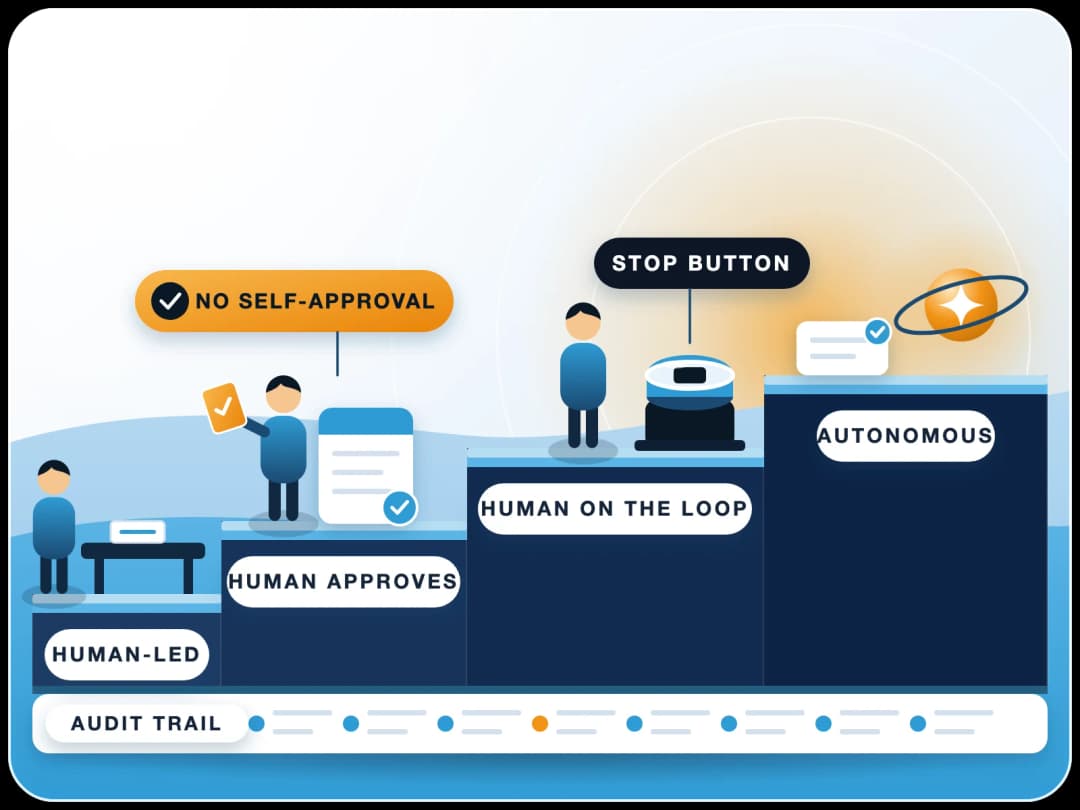
What Jobs Will AI Replace? A Role-by-Role Guide for Owners
AI is replacing tasks first, not whole jobs. Here's what the 2025-2026 studies actually say, which tasks AI agents already take over in finance, operations, sales, HR and customer service, and how to plan hiring and retraining around it.

- Jobs created by 2030 in the WEF forecast
- 170M
- Jobs displaced by 2030 in the same forecast
- 92M
- Workers worldwide in jobs with some GenAI exposure (ILO, 2025)
- 1 in 4
- Firms investing in AI that cut staff because of it (EY, 2025)
- 17%
The short answer
Will AI replace jobs, or change them?
In short
Mostly change them, at least so far. AI is replacing tasks first, not whole jobs. Most exposed are roles built from routine screen work: data entry, cashiers, bank tellers, basic bookkeeping and first-line support. So when owners ask what jobs will AI replace, the useful answer is a list of tasks inside each role, and a plan for the people who do them today.
Every large study agrees on one thing: far more jobs are exposed to AI than are being removed by it. This guide is written for business owners and managers. There's a short section for employees at the end.
ILO and NASK, 20 May 2025
One in four workers worldwide is in an occupation with some exposure to generative AI. The authors expect most jobs to be transformed rather than made redundant, because people are still needed for part of the work.
IMF, 14 January 2024
Almost 40% of global employment is exposed to AI, about 60% in advanced economies. Roughly half of those exposed jobs may benefit from AI rather than be displaced by it.
Stanford Digital Economy Lab (Brynjolfsson, Chandar and Chen, revised 12 August 2026) found no evidence of widespread, economy-wide job displacement in US payroll data. "Exposed" means a big share of a job's tasks could be done or sped up by AI. It doesn't mean the job disappears, and that gap is where an owner's decisions sit.
The numbers
How many jobs will AI replace?
Short answer
Nobody can give one honest number. The most quoted forecast, from the World Economic Forum, expects 92 million jobs displaced and 170 million created between 2025 and 2030, a net gain of 78 million.
The Future of Jobs Report 2025 (published 8 January 2025) is based on a survey of more than 1,000 employers with over 14 million workers across 55 economies.
Those employers said they'd respond in three ways:
- 85% plan to upskill staff
- About two-thirds will hire AI skills
- 40% expect to cut staff where AI automates tasks
| Forecast to 2030 (WEF, 2025) | Figure |
|---|---|
| New jobs created | 170 million |
| Jobs displaced | 92 million |
| Net change | +78 million |
| Share of today's jobs affected | 22% |
| Share of core skills expected to change | 39% |
What's happening on the ground is smaller
In an EY survey of 500 US business leaders (reported 9 December 2025), only 17% of companies investing in AI said its productivity gains had led to fewer staff. More of them were putting the gains back into the business.
Forecasts talk about 2030. Payrolls today move slower than the headlines, and most firms are still working out which tasks to hand over first.
- 17%
- Said AI gains led to fewer staff
- 42%
- Put gains into new AI capabilities
- 38%
- Put gains into upskilling or reskilling
Jobs at risk
Which jobs are most at risk from AI?
Short answer
Risky roles share three traits: the work is on a screen, it follows rules, and the output is easy to check. WEF names clerical and administrative roles, such as cashiers, data entry clerks, postal workers and bank tellers, among the fastest declining. The ILO also puts clerical work at the top of its exposure scale.
Two details matter for planning:
Entry-level work is hit first
Substitution and support behave differently
There's a gender gap too. The ILO study puts 4.7% of women's jobs worldwide in the highest-exposure category, against 2.4% of men's, mainly because women are over-represented in clerical roles. If your back office is mostly women in clerical jobs, start your retraining plan there.
Role by role
Which tasks can AI agents take over today, role by role?
How we map it
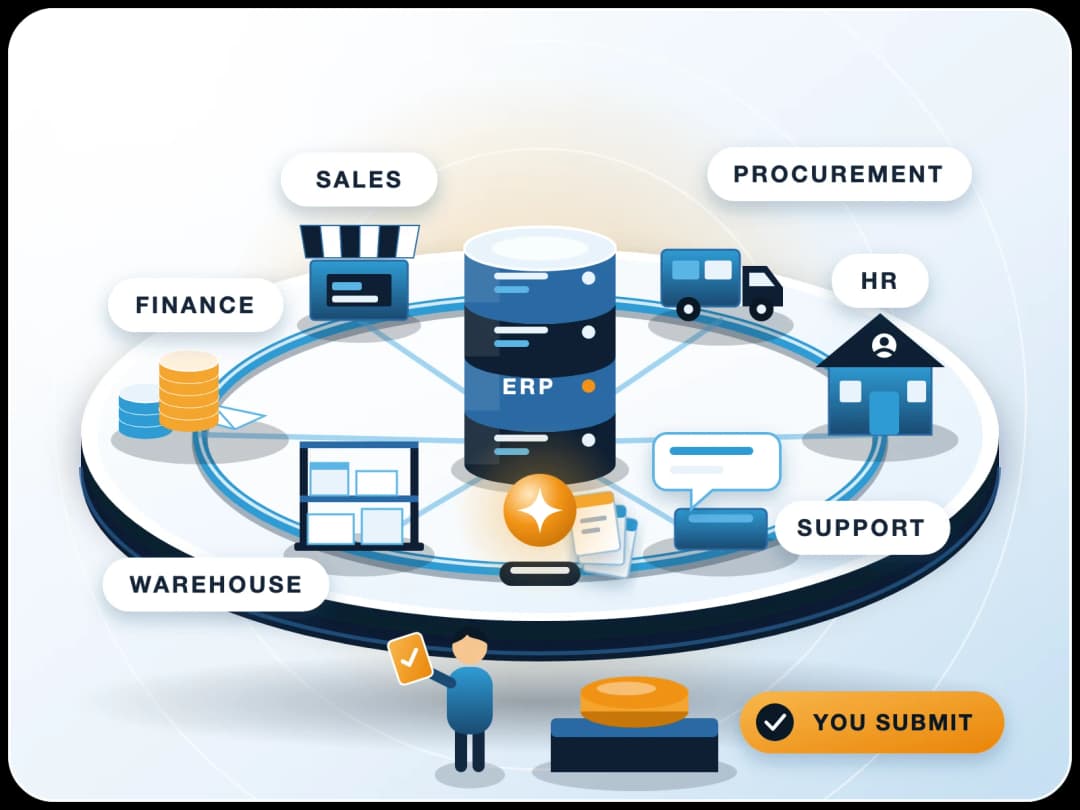
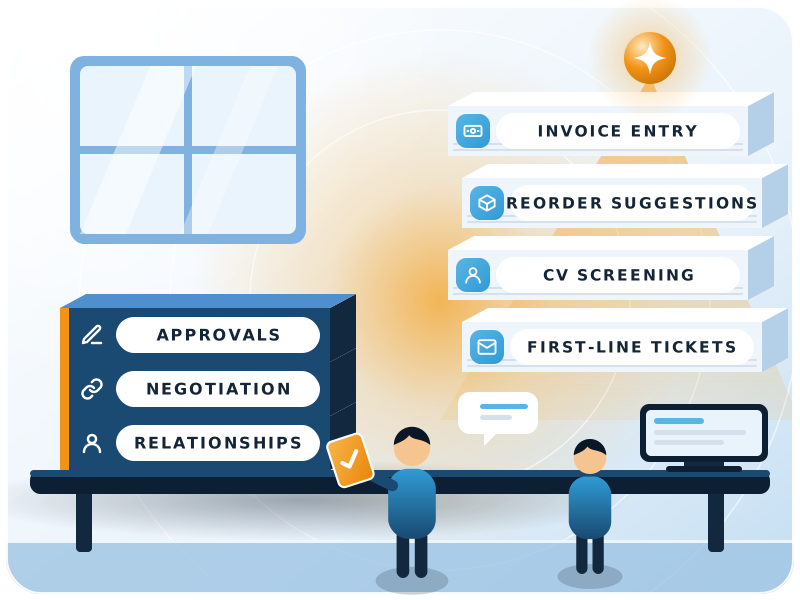
This is the table we use when we sit down with an owner to plan AI agents on top of their ERP. It lists tasks, not job titles, because that's how the change actually lands.
| Function | Tasks AI agents handle well today | Tasks that stay with people | How the role changes |
|---|---|---|---|
| Finance and accounts | Reading supplier invoices into draft entries, bank reconciliation matching, payment reminders, first-pass expense checks | Approving payments, disputed items, tax positions, auditors and banks | Fewer data entry clerks; accountants review exceptions instead of typing |
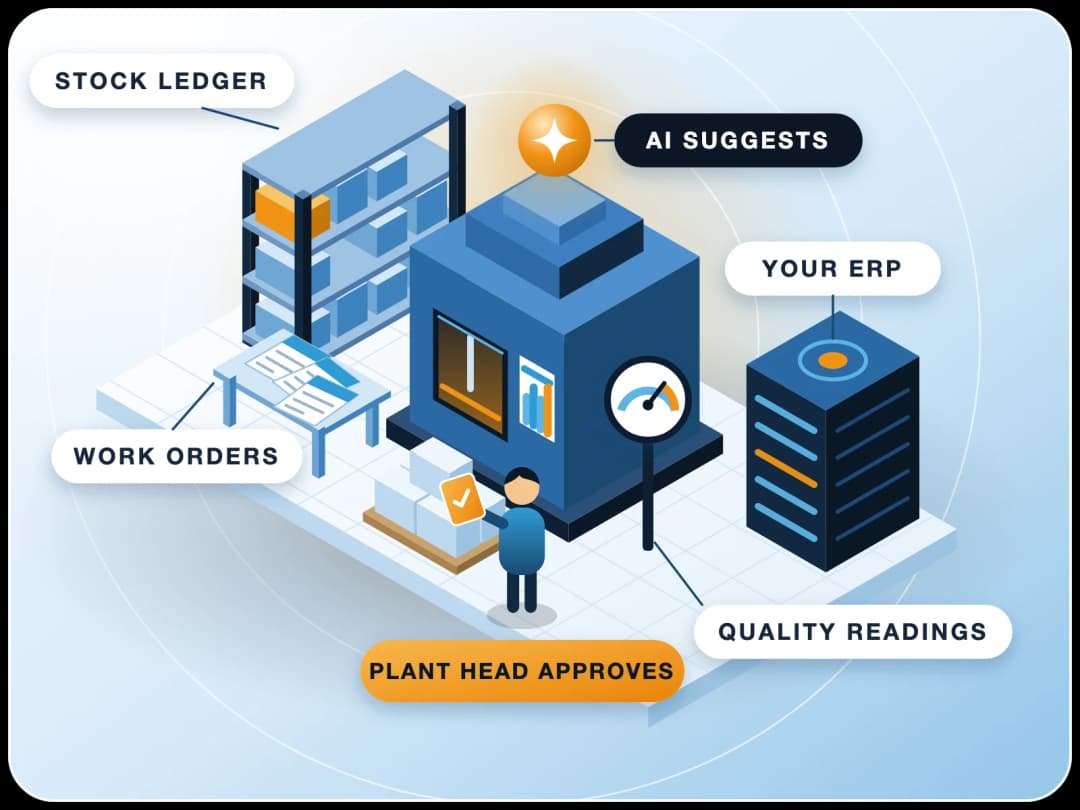
| Operations and purchase | Reorder suggestions from stock and lead times, supplier delivery tracking, daily status reports, chasing overdue POs | Supplier negotiation, trade-offs when stock is short, quality sign-off | Buyers spend time on suppliers, not spreadsheets |
| Sales | Lead research, first-draft quotes from past orders, follow-up reminders, CRM notes from calls | Pricing, relationships, complex deals, reading the customer in the room | Smaller support team per salesperson; reps own more accounts |
| HR | CV screening against stated criteria, interview scheduling, policy Q&A, onboarding checklists, attendance exceptions | Final hiring calls, performance talks, grievances, culture | HR executives move from admin to people work |
| Customer service | First-line answers from a knowledge base, order status lookups, ticket triage, drafting replies | Angry or complex customers, refunds outside policy, legal risk | Fewer first-line agents; more senior agents on escalations |
What it looks like in each team
Finance: start here
Operations and purchase
Sales
HR
Customer service
A common mistake
We cover the architecture in our guide to deploying enterprise AI agents on ERP, and the wiring between tools in n8n AI agent orchestration.
Safer ground
Which jobs are safest from AI?
Jobs are safer when they need one or more of these:
Physical work in changing places
Judgement with accountability
Trust and persuasion
Building and running AI
Safe doesn't mean unchanged. Almost every one of these roles will use AI for its paperwork.
Owner's plan
What should a business owner do about AI and jobs?
Here's the order we suggest. It works for a 30-person trading company and a 500-person manufacturer alike.
- 1List tasks, not rolesFor each team, write down the 10 tasks that take the most hours. Mark the ones that are on-screen, rule-based and easy to check.
- 2Check the data behind those tasksIf invoices, stock entries or leads aren't in the ERP on the day they happen, an agent has nothing reliable to work from. Fix that first.
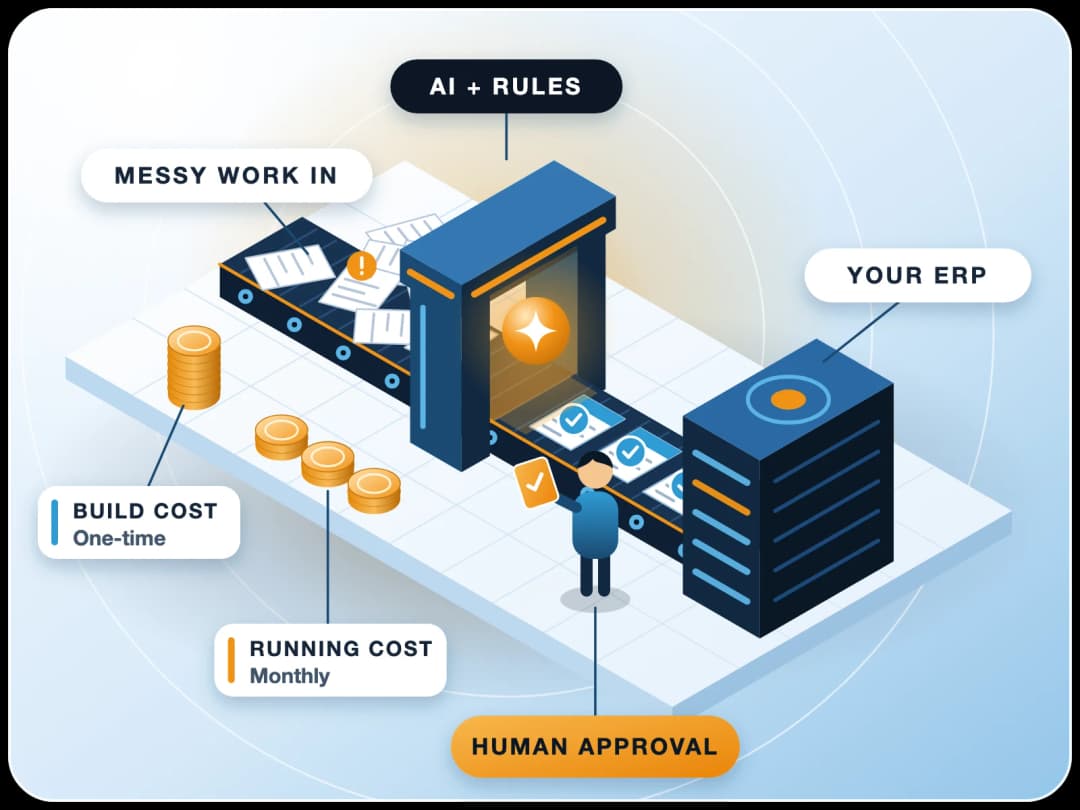
- 3Automate one task per team, read-only firstLet the agent report and draft. People approve. Measure one number, such as hours per week or errors per month.
- 4Decide what freed time is for, before you startMore customers per person, a faster close, better follow-up. If the answer is "fewer people", say so early and plan notice and redeployment honestly.
- 5Retrain the people closest to the workThe clerk who knows every supplier's invoice quirks is your best agent reviewer. WEF's employers put upskilling first (85%) for a reason.
- 6Change hiring, carefullyYou may need fewer junior data-entry hires. You still need to grow the next generation of accountants and buyers, so redesign junior roles around reviewing AI output rather than cutting them to zero.
Want help choosing and running the first use cases? Our guide to what an AI automation agency does and how to choose one explains the options.
Limits
When is replacing people with AI the wrong call?
Don't automate a task just because you can. It's the wrong call when:
The process is broken
Errors are costly and hard to spot
The volume is tiny
The person is the relationship
We usually see the best results where the agent takes the dull 70% of a task and the person keeps the 30% that needs judgement.
For employees
What does this mean if you're an employee?
Short answer
Look at your own week as a list of tasks. The ones a rule could describe are the ones AI will take. Get good at the rest.
- Checking AI output
- Handling exceptions
- Talking to customers and suppliers
- Knowing when a number looks wrong
About two-thirds of the employers in the WEF survey plan to hire people with AI skills. Being the person who can run and review AI agents is a good place to be.
Next step
Where FinByz fits
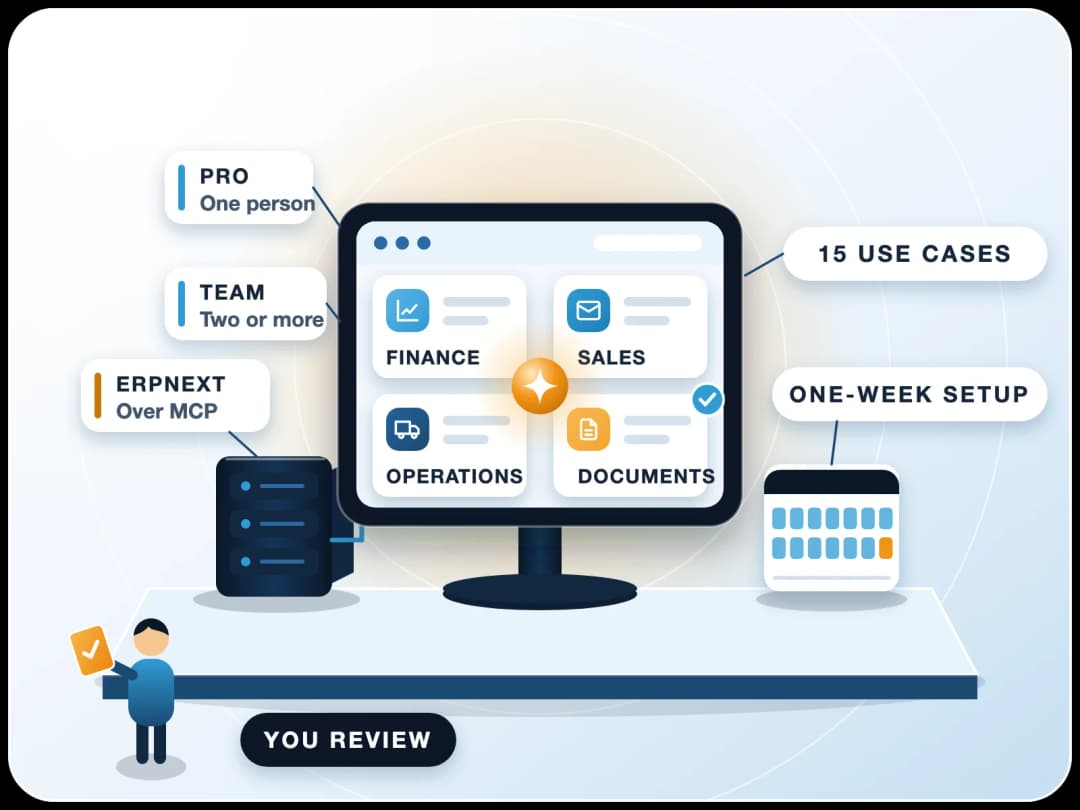
FinByz has implemented ERPNext and business automation since 2016, across 200+ projects in 15+ countries, with a 50+ person in-house team. We help owners pick the first tasks to automate, set up AI agents on ERPNext with the ERP's own permissions and approvals, and build the workflows with our AI automation services and n8n automation.
Talk to us if you want a task-by-task plan for your team.
- Task list per team, marked for AI
- ERP data check behind those tasks
- AI agents with ERP permissions and approvals
- One measured task per team at a time
Sources
- World Economic Forum: Future of Jobs Report 2025, press release, 8 January 2025
- ILO and NASK: Generative AI and Jobs, 2025 update, 20 May 2025
- UN News: One in four jobs at risk of being transformed by GenAI, 20 May 2025
- IMF, Kristalina Georgieva: AI Will Transform the Global Economy, 14 January 2024
- Stanford Digital Economy Lab: Canaries in the Coal Mine? Six Facts about the Recent Employment Effects of AI, revised 12 August 2026
- CFO Dive: Firms' AI goals prioritize growth over job cuts (EY survey), 9 December 2025